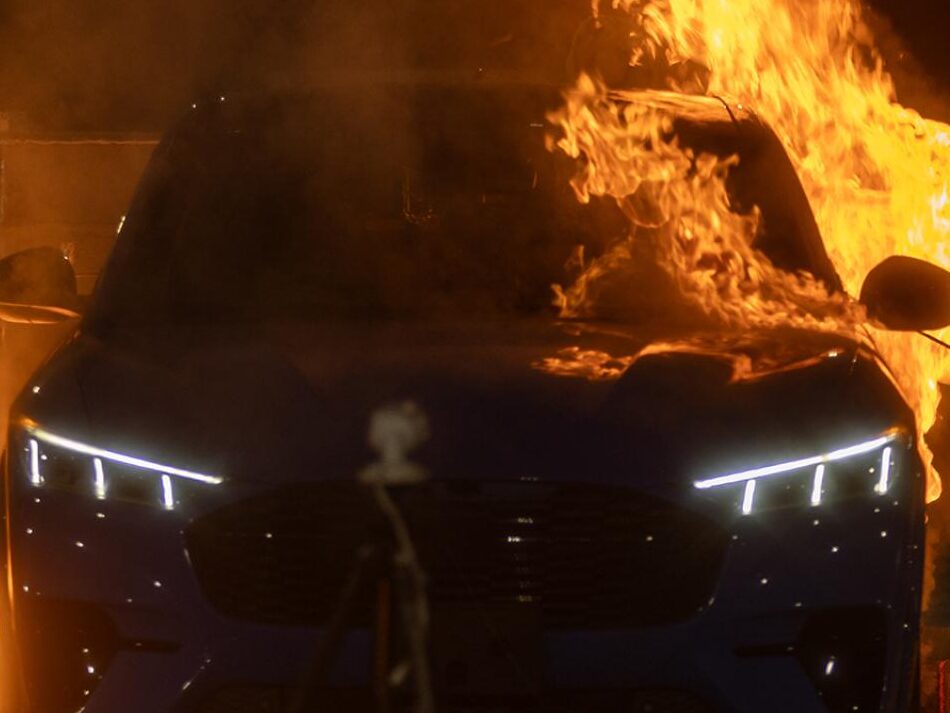

Adam Barowy from UL Research Institutes explains what firefighters should know when it comes to tackling electric vehicle fires.
As people become more eco-conscious and governments push for the uptake of EVs, firefighters are having to adapt how they approach vehicle fires. Earlier this year, UL Research Institutes’ Fire Safety Research Institute released a report entitled “Full-Scale Electric Vehicle Fire Experiments and Recommendations for Fire Incident Response” which aimed to help close the knowledge gaps around EV fires and suppression tactics.
The research was led by Adam Barowy, who set out to create a clearer understanding of how batteries can change the fire environment, equipping firefighters with the know-how to effectively address EV fires. Here, he tells International Fire Buyer why being presented with an EV fire should not be a cause for firefighters to dramatically change tactics.
Please introduce yourself and your background.
I’m a Principal Research Engineer with the Fire Safety Research Institute. I have been doing fire research and fire safety since about 2004. I have been with FSRI since 2022 and with UL for 13 years. We address hot spots where the biggest problems are and to come up with solutions predominantly for the fire service, but also for fire protection engineers, fire marshals, authorities have jurisdiction.
Your team recently conducted live burn experiments on EVs to evaluate the most common suppression tactics. Can you talk us through the practical elements of the experiments?
We saw effectively three major approaches to how firefighters were discussing fighting fires, and there was a growing camp reflecting frustration with the stubbornness of extinguishing EV fires. That was the “Let It Burn” approach, or in other words, just letting the fire burn until the battery is gone and then haul away the remains. And then there was the traditional vehicle fire approach which is to use the water that they bring with them on the fire engine to the scene. Also, there was a growing use of fire blankets because they can have dramatic immediate effectiveness in controlling the flaming part, but not necessarily the whole incident.
There are other suppression methods that are on the fringe, like alternative technologies, that are not so popular in the mainstream; there are a lot of products that have come around to fill the void to hopefully help extinguish these stubborn fires. We dipped into those a little bit, but frankly, we left those to the side because we are a bit North America-centric and whilst we want to serve the globe, we really need to have the best answer with what is already deployed and paid for. We wanted to explore what the true limitations were and how to work beyond that.
What were the key findings from your research?
In pursuing those questions about which things are effective and when do you do them, we burned 18 vehicles. Nine vehicles were left to burn; we set them on fire and then let them burn all the way out. Then we burned 9 more but tried combinations of those suppression approaches.
The findings were that those other methods can be effective, but our primary recommendation is the use of water first. If you look at the construction of these vehicles, if you take away the gas tank and the battery, they are all the same things; it is a big metal box full of plastics, and that is a very easily controlled fire. We had this moment of realisation where we said: the fire service already knows how to address these fires, so the problem is specifically with the battery. The reason that is important is because we have found from data from the Netherlands that more than half the time, the fires of an EV do not yet involve the battery. Therefore, the first step out the gate is, while you may not know what the vehicle is, you begin to suppress; that helps to identify the vehicle, and it takes care of the major part of the fire.
Most of the fire is coming from the vehicle’s interior so the thermal hazard goes down and the chemical hazard goes down. You may fully extinguish the vehicle anyway and you may, in the process, also find out that it is an EV. So, this one quick action is already available, it is very effective, and it may be completely effective. If not, then you have reduced the hazard going on, and you may very quickly find out if you have truly got this stubborn fire that you then need to start to manage.
From there, the batteries are watertight from the factory, so we already have this barrier to get over of how you get water inside the battery where the fire is burning, and that proves to be very difficult. We disassembled the batteries later on, and found out that the battery pretty much completely burned out in everything except a Tesla. That is why we are saying water first and then there are those alternative methods. Maybe then you decide you need to control smoke, and then you could use a fire blanket. But this one tool is widely available, and we expect it to be very effective.