
Keith Creely from Ziamatic explains how decades of engineering experience continue driving safer, more adaptable SCBA mounting solutions for today’s fire apparatus.
Please introduce yourself and give us an insight into your background
My name is Keith Creely, and I am the Vice President of Ziamatic Corp. This November will mark my 31st year with the company. I joined Ziamatic to help organise and maintain the warehouse, and over the years I have progressed through a variety of roles, including assembly, technical assembly, sales, and multiple management positions before assuming my current role as Vice President.
With extensive experience in our products, including assembly, mounting methods, installation, and operation, I regularly support our sales team and customers by troubleshooting issues and identifying the best solutions for specific applications.
In my day-to-day role, I collaborate closely with our Engineering and Research & Development teams. My primary focus is identifying challenges within the emergency response industry, developing practical solutions, and helping design cost-effective, user-friendly options that meet the evolving needs of our customers, and then bring these products to market.
With more than 60 years of experience designing equipment for fire and EMS vehicles, how has Ziamatic’s approach to SCBA storage evolved, and what lessons have shaped the design priorities of today’s mounting and retrieval systems?
Ziamatic was founded on a simple idea: securely storing SCBAs in fire apparatus. As firefighters themselves, the founders wanted to keep heavy steel SCBAs mounted in the truck instead of carrying them in and out of the station. Their solution, a pair of formed steel “C” clips riveted to a steel backplate, became Ziamatic’s first SCBA bracket. As neighboring departments saw its effectiveness, demand quickly grew.
As SCBA technology evolved, so did Ziamatic’s mounting solutions. Cylinders transitioned from steel to aluminum and eventually to lightweight composite (carbon fibre) construction, while air capacities and cylinder sizes expanded. These changes required brackets with different clip sizes and mounting positions. The introduction of composite cylinders also led to PVC coated clips, providing a more secure, non-abrasive method of retention that protected the cylinder surface.
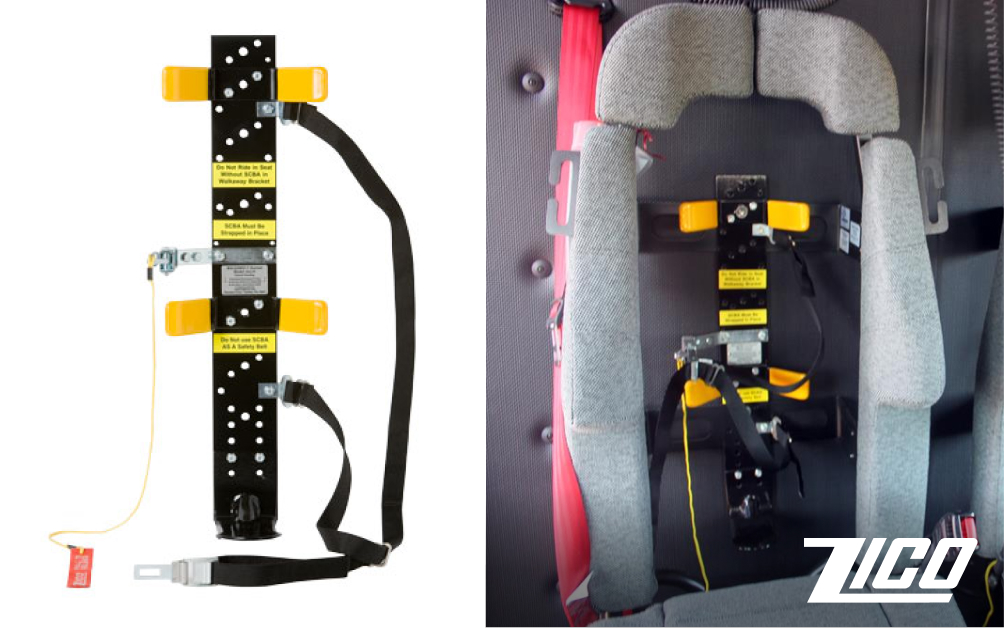
As NFPA safety standards evolved, SCBA mounting systems were suggested to withstand greater retention forces during vehicle collisions. In response, Ziamatic engineers developed a three-point harness with a locking latch and pull-lanyard release – a proven design that remains in production today.
As SCBA manufacturers added new technology, the cylinder area became too congested for traditional retention clips. Ziamatic responded by introducing V-style rests and low-profile clips, which are now the most common configuration used on our Walk Away Spring Clip brackets.
For departments that preferred a strapless solution, Ziamatic developed mechanical brackets. The first generation secured the cylinder with contoured side clamps and a locking cam, but increasingly complex SCBA designs limited their compatibility. This led to a top-and-bottom retention design, resulting in the QM-EZL-F mechanical SCBA bracket. Today, it remains one of the emergency response industry’s most dependable and cost-effective strapless SCBA mounting solutions.
We have learned that keeping pace with evolving standards and continuous SCBA design changes is essential to ensure our mounting brackets remain safe, reliable, and easy to use. Maintaining strong relationships with SCBA dealers and fire departments is equally important. By listening to their feedback and understanding their challenges, we continue to improve our products and provide mounting solutions that meet the needs of today’s emergency responders.
TO READ THE FULL ARTICLE, READ OUR NEW ISSUE.