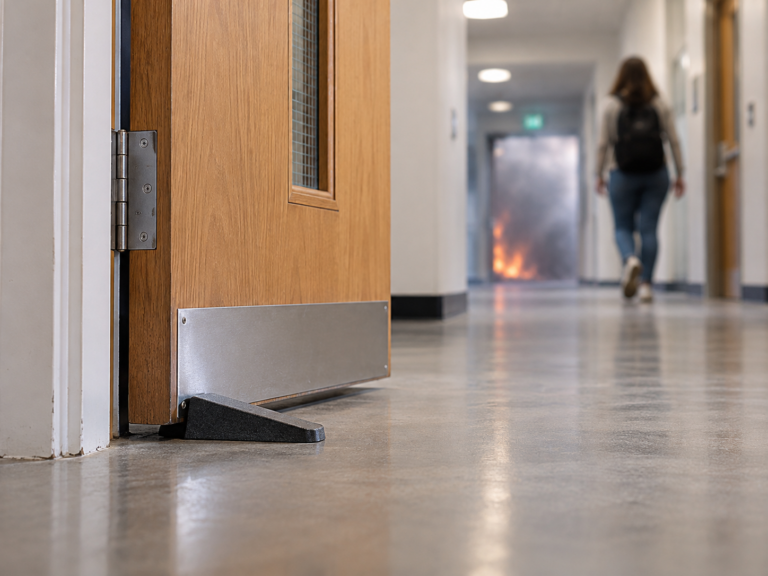


UK Fire Door Training has launched Fire Door Anatomy, a free interactive digital learning platform designed to improve understanding of fire doors, their components and their role in building fire safety.
The resource combines interactive 3D models with approximately 19,000 words of technical content, allowing professionals across the built environment to explore fire door construction, specification and inspection considerations.
Interactive models explore fire door components
Fire Door Anatomy allows users to examine ten common fire and escape door components through an interactive 3D assembly.
Users can rotate and dismantle the model, investigate the internal workings of a door closer and access information covering materials, relevant standards, common defects and inspection requirements.
The platform also features an exploded fire door assembly to demonstrate how individual components fit together.
Fire test simulation highlights potential defects
An educational fire test simulation enables users to configure a door specimen and introduce faults to explore their potential consequences.
Scenarios include oversized gaps, unsuitable glazing and missing intumescent protection around a lock.
The simulation is intended to demonstrate fire door performance principles rather than predict how an individual door would perform during a real fire.
Technical content undergoes independent review
UK Fire Door Training believes the platform is the first interactive 3D learning resource in the UK dedicated specifically to fire doors.
During development, two independent consultancies reviewed the technical content, producing a combined 134 pages of assessment. Reviewer feedback was considered and incorporated before the platform’s launch.
Further learning resources planned
The platform includes knowledge checks to help users assess their understanding of fire door components and associated safety considerations.
Fire Door Anatomy forms part of UK Fire Door Training’s wider programme of product and service development, with additional educational tools planned over the next 12 months.
Jonny Millard, Managing Director of UK Fire Door Training, said: “We wanted to build the fire door learning resource we felt the industry should already have.
“Fire doors are physical systems but much of the learning around them is still delivered through flat images, slides, diagrams and PDFs. Those formats still have an important place but they shouldn’t define the limit of what fire safety education can be.
“Fire Door Anatomy is designed to make technical information easier to explore without sacrificing depth. We’ve also made the whole resource free because we want useful fire door knowledge to travel as widely as possible.”