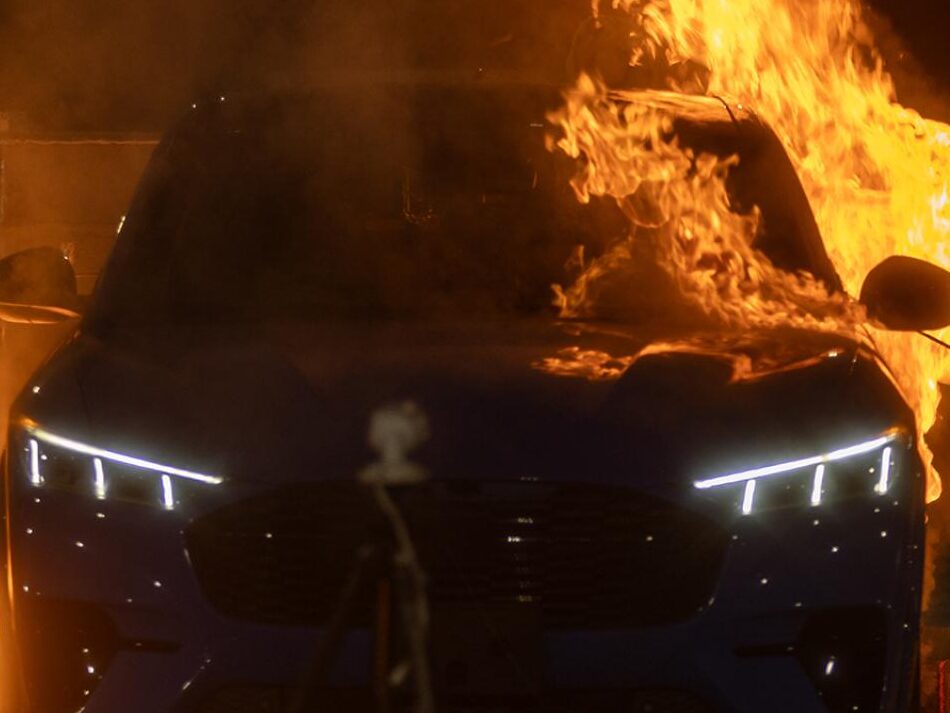

UL Research Institutes‘ Fire Safety Research Institute (FSRI) has published a new report examining electric vehicle (EV) fire behaviour and suppression tactics, providing firefighters with evidence-based guidance for responding to battery fires.
The report, “Full-Scale Electric Vehicle Fire Experiments and Recommendations for Fire Incident Response”, is intended to address knowledge gaps surrounding EV fires and support safer operational decision making.
Full-scale fire testing
Researchers conducted full-scale fire experiments on 18 vehicles, including nine uncontrolled burns and nine suppression tests involving electric vehicles.
All EVs were fully charged before battery fires were initiated using a propane burner. Fires were allowed to develop for six minutes before suppression began, reflecting the average emergency response time in North America.
The suppression trials evaluated the effectiveness of water alone, EV fire blankets and water combined with a suppression agent.
Key operational findings
The study found that EV and internal combustion engine vehicle fires behave similarly in terms of fire growth, peak fire size and overall fire duration.
However, EVs released more total energy on average, largely due to their greater vehicle mass.
Researchers concluded that water remains the most effective method for controlling vehicle fires, limiting fire spread and reducing exposure while allowing battery thermal runaway to burn out.
None of the suppression methods tested stopped thermal runaway once it had started, and adding a suppression agent provided no additional benefit over water alone.
Fire blanket guidance
The report advises caution when using EV fire blankets. Although blankets can control external flames, researchers found they may allow flammable gases to accumulate beneath the blanket, creating an explosion risk, particularly in enclosed environments.
FSRI recommends blankets should not be repositioned once deployed and should not be used indoors or in confined spaces because of the potential for deflagration. They should also not be regarded as a replacement for water-based suppression.
Firefighter safety
The research emphasises that firefighters should remain in full personal protective equipment and self-contained breathing apparatus throughout the incident, including during overhaul operations, because of persistent toxic hazards and the potential for reignition.
Researchers detected elevated concentrations of metals and particulate fluoride associated with battery fires in smoke, firefighting runoff and contaminated turnout gear.
The report also introduces an EV Fire Tactical Decision Aid to support fireground decision making. The findings will be incorporated into a new EV firefighting course within the Fire Safety Academy later this year, while further research into air quality, contamination, water runoff and PPE decontamination will be published over the coming year.
Adam Barowy, principal research engineer for the Fire Safety Research Institute, said: “Lithium-ion battery-powered devices and EVs are already changing how we move, communicate, and enjoy our leisure time.
“This research moves us closer to understanding how batteries change the fire environment and helps equip first responders to adequately address fires involving this new source of fuel.
“Our findings demonstrate that when it comes to EVs, first responders can effectively manage the hazard with familiar tools and tactics.”