
WATERAX explains how portable pumping systems help wildfire crews overcome distance, elevation and difficult terrain to deliver reliable water where operations demand it most.
Wildland firefighters rarely have the luxury of fighting fire next to an unlimited, pressurised water source. A lake may be nearby, but a hundred metres or more below the fire. A river may be accessible only on foot. A hydrant may be kilometres away. Portable water tanks, brought directly to the fireground by firefighters or delivered by helicopter may be positioned in difficult-to-access locations. A crew may have hundreds of metres of hose between the pump and the nozzle. In the wildland-urban interface, water may exist in swimming pools, ponds, reservoirs or tanks, but still needs to be moved efficiently to structures under threat.
In all of these situations, finding water is only the beginning. The real challenge is getting enough water, at the right pressure, to where firefighters need it.
As wildfire operations grow more complex, water delivery deserves its own place in operational planning. Distance, elevation, terrain, available water sources, required flow and equipment portability all influence how successfully water can be moved from the source to the fireline. For crews working far from any hydrant, understanding those variables is part of the job.
Water is available. Access is the challenge
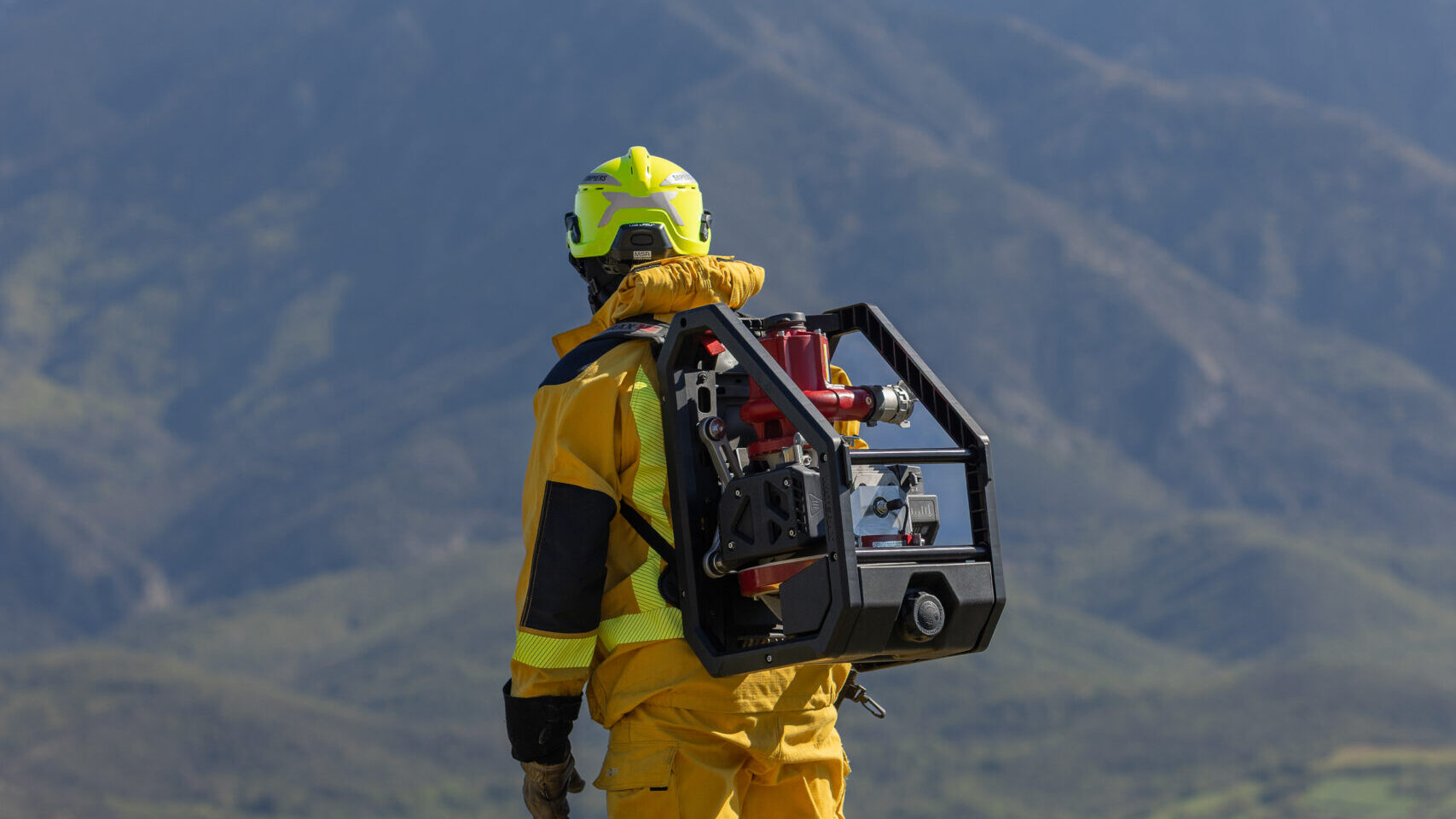
Wildland firefighting has always required adaptability. Crews may draft from lakes, rivers, streams, ponds, swimming pools, irrigation reservoirs, portable tanks or virtually any other accessible water source. Portable fire pumps allow firefighters to bring pumping capability directly to those sources, including places conventional fire apparatus may never reach. Reaching the water does not solve the problem on its own, because the water still has to travel.
In some operations, that might mean about 100 m of hose. In others, it can mean a kilometre or more across changing terrain and significant elevation. Every metre of hose and every metre of climb affects what reaches the nozzle.
Distance changes everything
Water moving through hose encounters resistance. That resistance creates friction loss, reducing the pressure available farther down the hose lay. The longer the hose, the greater the cumulative effect.
Flow rate, hose diameter, fittings, valves and the overall configuration of the system also influence friction loss. That is why a pump’s maximum pressure or maximum flow says little on its own. What counts is the pressure and flow left at the end of the hose lay.
If firefighters need a specific pressure and flow at a nozzle hundreds of metres or more from the water source, the pumping system must provide enough performance to overcome losses along the way while still delivering the required nozzle pressure.
The goal is enough water, at the right pressure, in the right place, for as long as the operation needs it.
Elevation: Distance is only part of the equation
Moving water uphill requires the pump to overcome the weight of the water column itself. As elevation increases, additional pressure is required simply to lift the water before friction loss and nozzle requirements are considered. This becomes particularly important in mountainous terrain, remote wildland operations and communities built along slopes and ridgelines.
A lake that looks close to the fire on a map can be a long way off in hydraulic terms. Understanding elevation, friction loss and required discharge pressure allows crews to build water-delivery systems around actual fireground requirements rather than assumptions. The answer might be a higher-pressure pump, a larger hose diameter or a second pump farther along the lay.