

Ahead of the International Water Mist Conference next month, Sami Autero, Director, Service and Aftermarket, Global Land Business, Marioff Corporation, talks about the benefits of the technology and preventative maintenance.
Please introduce yourself and your background.
I have been running Marioff’s service business globally for two-and-a-half years, concentrating on the land applications. Before I joined Marioff, I was working in the global development of service business in publicly-listed companies that were focussed on the flow of goods and people.
Please tell us about Marioff Corporation, what it does, and its history.
Marioff was started in 1985, however, the water mist technology was introduced in 1991 after a tragic fire in 1990 involving a vessel called the Scandinavian Star in which 159 lives were lost. That was an event that drove Marioff to develop the water mist technology. Marioff as a company is a pioneer of water mist technology and this innovation has been taken further; we have our own research and development, and our own manufacturing in Finland. That is where innovation and very deep knowledge has come from and been applied both to the sea and land applications in very demanding conditions. We have also been servicing thousands of sites over the last few decades, which has enabled us to know how to keep these systems up and running.
What are the main benefits of water mist fire protection?
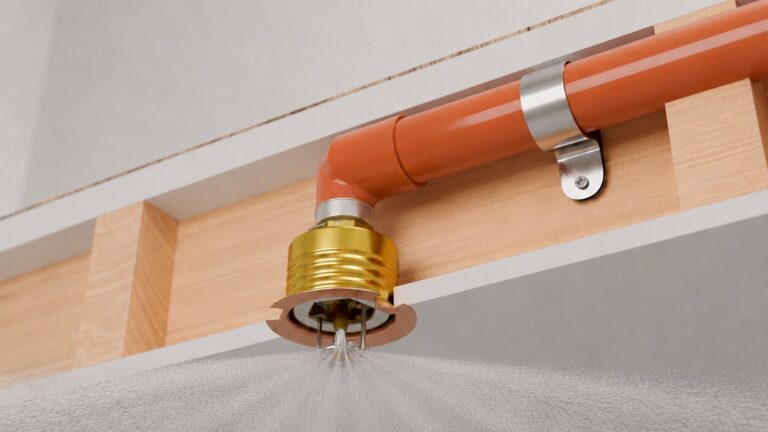
There are two main benefits of water mist fire protection. The first is its effectiveness and performance in fire suppression; high pressure water mist uses multiple processes to suppress the fire, whilst traditional sprinklers only have one element which is wetting the material. Secondly, water damage is kept to the very minimum compared to the other technologies that use water. With its high velocity and high pressure, the technology forms a mist curtain that absorbs the radiant heat from the fire, blocking it inside the mist which cools the fire. In this way, we are able to capture the upwards spread of heat from the fire.
Unlike traditional sprinklers, the very small water droplets evaporate and the higher the temperature of the fire, the faster the speed of evaporation process which blocks the oxygen. Another element is the wetting of the material, just like traditional sprinklers. So there are three key elements of the technology that suppress the fire. We are able to use a fraction of water compared to traditional sprinklers to achieve the same fire suppression performance.
What applications are most suitable for water mist fire protection?
Our key sea applications range from large cruise ships and different vessels such as container ships. On the land side, we have industrial customers such as data centres, oil and gas, power generation, gas turbines and different kinds of oil drilling platforms. We also have a very large manufacturing domain for customers such as car manufacturers, robotic factories, and the food industry. We also have buildings such as high-rise offices and hospitals where evacuation during a fire can be very difficult.
In terms of heritage sites, we have plenty of landmarks around the world that are priceless. We can build the piping network in the building to be very lean, meaning it is easy to lead through heritage buildings; we can hide the piping network of the water mist because it is much smaller in dimension than traditional sprinklers. Heritage buildings are one very strong area where the water mist can be successful.