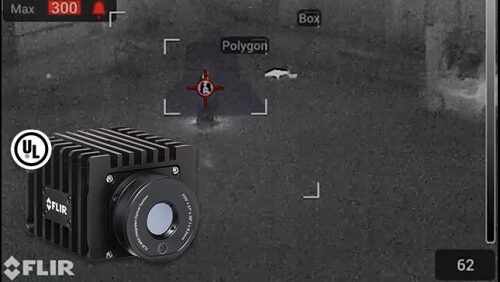

Teledyne FLIR’s A40 and A70 thermal imaging cameras have become the first models to achieve UL 2684 listing as thermal image fire detectors.
The cameras are listed under ANSI/CAN/UL 2684, the standard covering video and thermal image detectors for fire alarm systems.
Although UL 2684 is a North American standard, Teledyne FLIR said the listing can provide additional independent evidence for fire engineers and risk professionals specifying thermal image detection on European projects.
Supporting European fire detection
Radiometric thermal image detection does not currently have its own harmonised European product standard. Systems can instead be assessed through project specific approval routes and national certification schemes, including VdS in Germany and CNPP in France.
European regulatory requirements, CE marking obligations and applicable EN 54 standards continue to apply.
The UL 2684 assessment includes fire performance testing involving flaming wood, flammable liquids and polyurethane, alongside environmental, electrical and durability testing.
Monitoring developing fire risks
Radiometric thermal cameras continuously measure temperatures across their field of view.
Teledyne FLIR’s Early Fire Detection solutions can monitor defined areas and provide minimum, average and maximum temperature readings. Alarms can be configured around absolute temperature thresholds, differences between monitored areas and rates of temperature increase.
Potential applications include waste and recycling facilities, manufacturing equipment, battery energy storage installations, data centres and rooftop solar arrays.
Thermal imaging complements fire detection
Thermal imaging requires a direct line of sight and can be used to monitor specific assets, including switchboards, battery enclosures and conveyors.
Teledyne FLIR said the technology is intended to operate alongside conventional fire detection rather than replace it.
The cameras also incorporate visible imaging, allowing operators to receive visual information alongside thermal alarms.
For European projects, the UL 2684 listing can provide supporting technical evidence while applicable European, national and project specific approval requirements remain in place.
Matthew Hasty, Global Vertical Director for Science, Automation, and Early Fire Detection at Teledyne FLIR, said: “Fire engineers work from evidence, and the strongest evidence is a published benchmark with an accredited laboratory behind it.
“That is what the listing adds for Europe. It gives the people building the technical case something independent to build on.”