
Mario Flores Dahlström, Fogmaker’s Segment Manager for Construction Equipment, Mining and Tunnelling, discusses how to achieve cleaner, certified fire suppression for mining equipment.
Fire protection in mining has always been a high-consequence discipline. A fire on a heavy-duty mobile machine is rarely an isolated technical event. It can place operators at risk, damage critical assets, interrupt production, create environmental exposure, and trigger costly downtime in operations where availability is measured with discipline.
For decades, the central question was simple: can the fire be extinguished? Today, that question is no longer enough.
Mining operators, OEMs, insurers, and fire safety professionals are increasingly looking at the full chain of consequences. How quickly can the system act? Has its performance been verified under relevant conditions? What happens after discharge? How difficult is the clean up? What is the environmental profile of the suppression agent? Can the machine return to service without creating a second operational problem?
In heavy-duty mining applications, the right fire suppression system must do more than attack flames. It must support safety, uptime, compliance, and responsible environmental management.
A severe fire environment
Heavy-duty mobile equipment operates in one of the most demanding environments for fire protection. Engine compartments and adjacent risk zones may contain hot surfaces, turbochargers, exhaust components, hydraulic lines, fuel lines, filters, pumps, electrical components, and combustible residues. These hazards are exposed to vibration, contamination, dust, high thermal loads, and limited accessibility.
The challenge is not only the presence of fuel and ignition sources. It is the machine’s geometry. Fires may develop behind obstructions, around hot surfaces, under covers, near hydraulic components, or in areas that are difficult to access manually. Ventilation, airflow, and machine layout can also affect fire behaviour.
This is why mining fire suppression cannot rely only on theoretical agent capability. It requires a system approach: detection, activation, pressure, liquid formulation, distribution design, nozzle placement, installation quality, and application-specific risk assessment.
Beyond “water mist”
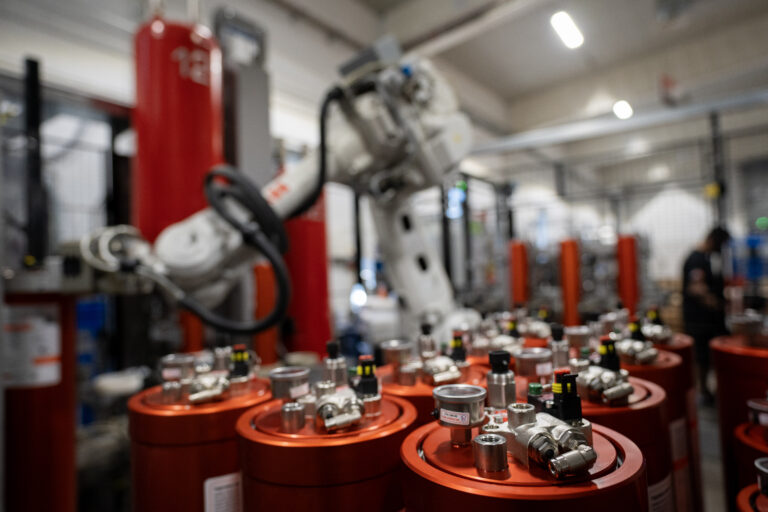
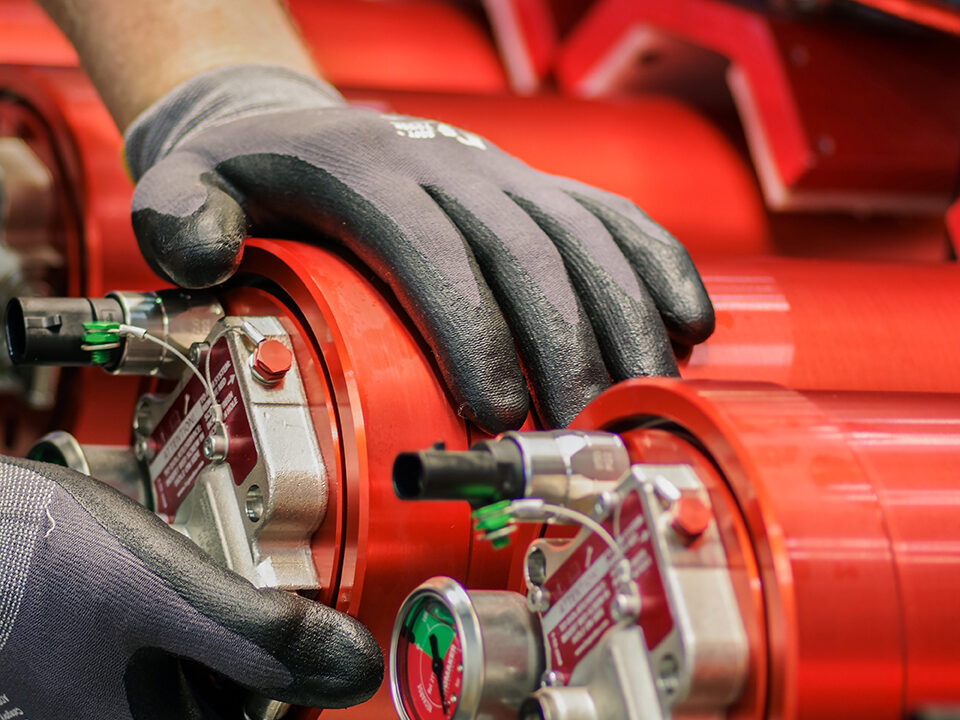
Fogmaker’s technology is sometimes described through the language of water mist, but that only tells part of the story. The system uses high-pressure atomisation of Fogmaker Eco 1, a proprietary water-based suppression liquid, delivered through a certified distribution and nozzle architecture designed for demanding mobile equipment environments.
Performance is not created by one element alone. It comes from the combination of liquid formulation, pressure, droplet behavior, nozzle design, detection, installation practice, and risk-based application engineering.
The fine mist generated by the system supports rapid cooling and effective distribution in protected risk zones. Fogmaker Eco 1 combines the performance characteristics of a purpose-developed suppression liquid with a high-pressure platform, enabling a compact system architecture for mobile equipment applications.
In mining, this distinction matters. A fire suppression system should not be evaluated as “agent only” or “hardware only.” It must be assessed as a complete technical platform.
TO READ THE FULL ARTICLE READ THE FULL ISSUE HERE.