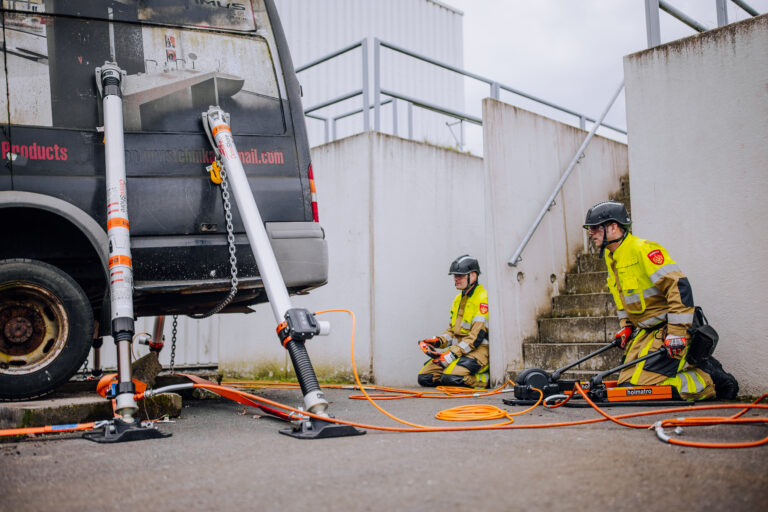
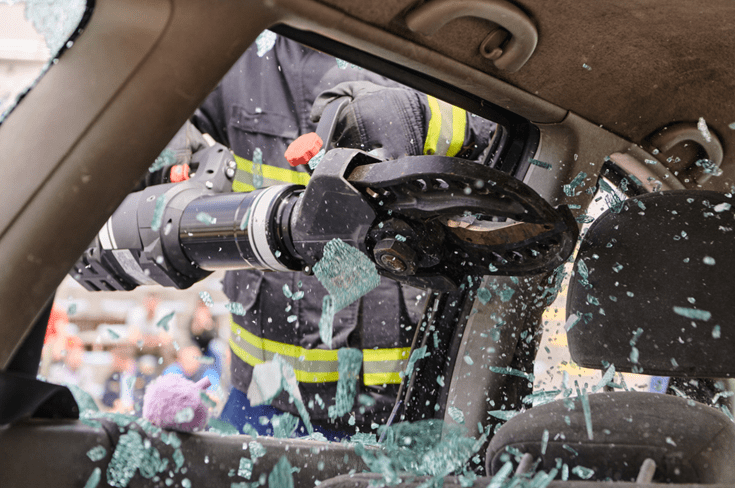

Rebecca Spayne of Fire Buyer examines how Urban Search and Rescue (USAR) demands precise lifting, stabilisation, and extrication techniques to safely remove victims
Urban Search and Rescue (USAR) has grown in complexity as cities expand, infrastructure becomes more advanced, and disasters become more severe. Firefighters responding to collapses, entrapments, and hazardous structural failures face increasingly difficult environments where speed, precision, and adaptability are crucial to success.
As cities continue to expand and high-rise developments become the norm, urban populations are increasingly at risk from both natural and man-made disasters. Large-scale infrastructure projects, underground transport networks, and densely populated urban centres add to the complexity of USAR operations. Emergency responders must navigate congested cityscapes, collapsed buildings, and unpredictable structural failures while ensuring both their own safety and the successful rescue of those trapped. The rapid pace of urbanisation also means that new materials and construction techniques are being introduced regularly, sometimes without sufficient testing against extreme conditions, making rescues even more challenging.
One of the major concerns in modern USAR operations is the impact of climate change-induced disasters on urban settings. Floods, hurricanes, earthquakes, and industrial incidents create scenarios where fire services must operate in unstable structures, confined spaces, or areas with limited access points. The increasing use of reinforced materials in modern architecture also presents additional challenges, requiring specialist cutting and breaching equipment to access trapped individuals. Emergency responders must also account for hazardous materials, gas leaks, and electrical hazards, all of which complicate rescue efforts.
Beyond natural disasters, urban environments also pose risks due to human-made emergencies, including gas explosions, structural fires, and terrorist attacks. The presence of critical infrastructure, such as power plants, transport hubs, and industrial complexes, means that even minor incidents can have cascading effects, requiring rapid and coordinated SAR responses. The unpredictability of these situations demands highly trained personnel equipped with state-of-the-art tools and technology to respond efficiently and effectively.
In a scenario where a 30-storey tower is struck by an earthquake, the top ten floors might partially collapse, compressing lower levels under extreme pressure. Firefighters must locate survivors in confined spaces filled with concrete debris, steel reinforcement, and unstable flooring. Traditional methods using acoustic listening devices and manual breaching tools would be time-consuming and increase responder risk. In this situation, modern search technology, cutting tools, and hydraulic stabilisation systems become essential for an effective rescue. The ability to rapidly assess structural integrity, identify survivors, and extract them efficiently is the difference between life and death.
Eyes Inside the Rubble
The first critical step in SAR operations is locating trapped victims efficiently. Without real-time intelligence, responders risk unnecessary excavation that could delay rescues or cause additional collapses. Modern search and reconnaissance tools provide an immediate advantage, allowing responders to assess structural integrity, detect survivors, and determine the safest route for access. However, locating victims in chaotic, collapsed environments presents multiple challenges, from debris shifting unpredictably to restricted visibility caused by dust, smoke, and low lighting. Traditional search methods, such as tapping on surfaces to listen for responses or manually searching void spaces, are slow and increase the risk of secondary collapse. Today’s advanced imaging and detection technologies allow firefighters to locate survivors without compromising their own safety, reducing the time needed for initial assessment and enabling more strategic rescue operations.
One of the most valuable tools for situational awareness is the FL360 spherical imaging system by First Look (Agility Corp). This compact, 360-degree visual reconnaissance device is specifically designed for use in collapsed structures and confined spaces. By inserting a ruggedised camera through a small opening, responders can obtain a complete panoramic view of the interior environment without physically entering dangerous zones.
The system provides real-time wireless transmission, enabling remote assessment from a safe distance, while infrared and low-light imaging capabilities allow responders to identify survivors even in complete darkness or through smoke-filled environments. Additionally, the device’s compact and lightweight design ensures it can be easily deployed in tight spaces without adding unnecessary weight to a firefighter’s gear. Its shock-resistant casing and waterproof housing allow it to be used in extreme conditions, including submerged areas or unstable terrain. Similarly, other products such as YONE Corps’ PROEYE 951-S also allows rescue personnel to locate victims trapped in confined spaces and collapsed structures with an integrated small Camera Head and Audio Sensor System….
To read the full article see our latest issue here.
Never miss a story… Follow us on:
LinkedIn: International Fire Buyer
Twitter (X): @Firebuyer
YouTube: @FireBuyerTV
Media Contact
Rebecca Spayne Managing Editor, International Fire Buyer
Tel: +44 (0) 1622 823 920
Email: [email protected]