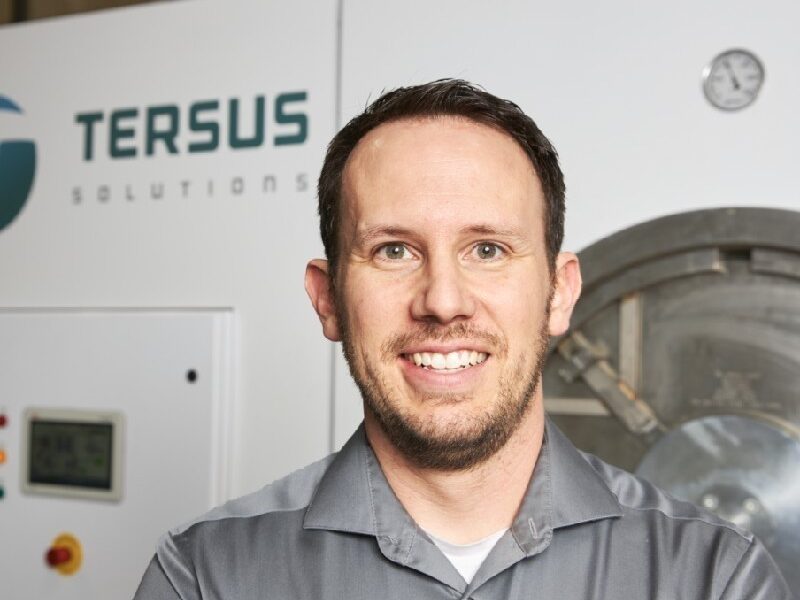

Chris Robbins, Chief Technology Officer (CTO) at Tersus Solutions, discusses the science behind liquid CO₂ decontamination, its role alongside water washing, and its potential to reduce firefighter exposure to harmful contaminants.
Firstly, please introduce yourself and give an overview of your background.
I’m Chris Robbins, CTO at Tersus Solutions. My background is in mechanical engineering, and I’ve spent the last 15 years here developing and refining our CO₂ cleaning process, applying it across textiles, military, and eventually the fire service. Day to day, my focus is on making sure the technology delivers. That means research and development, testing across both liquid and supercritical CO₂ applications, machine deployment, and continuous improvement of our cleaning efficacy. Ultimately it all comes back to one thing, getting firefighter gear as clean as possible.
What is the history of Tersus Solutions?
It started in 2012, when we demonstrated the world’s first CO₂ cleaning solution for cleanroom textiles and it outperformed water on both particle and bioburden removal. That gave us real confidence in where the technology could go. From there, we took it into the fire service, testing with the Belgian Federal Government showing Tersus could remove 95% or more of carcinogens from turnout gear. By 2016, we were working with the U.S. Navy and the California Energy Commission on military textiles, and that work surfaced something important from an operational standpoint; our process uses more than 30% less energy than conventional cleaning.
How does CO₂ decontamination work and where did the technology come from?
Liquid CO₂ cleaning has been around for a long time, but our founder perfected it for PPE. The physics are straightforward: CO₂ pressurised into a liquid state becomes an excellent medium for the non-polar, hydrophobic compounds that embed themselves in turnout gear after fireground exposure. The liquid CO₂ penetrates deep into the fibre matrix, dissolves those contaminants, and when the cycle completes and pressure is released, it simply vaporises and takes everything with it. No liquid waste, no residual solvent, no rinsing required. What Tersus built on top of that chemistry is the optimised process engineering including the cycle parameters, agitation dynamics, and pressure profiles protected under our patent that makes it work reliably and reproducibly for PPE.
What makes this technology suitable for advanced PPE decontamination?
Not all CO₂ is the same, so first let’s make that clear. What distinguishes our system specifically is that liquid CO₂ is the mechanism of action, not a rinse agent, or anything else. Our patented pump-and-compressor architecture actively circulates liquid CO₂ at 600–900 PSI throughout the entire cleaning cycle, with minimal detergent and no secondary solvents or reimpregnation chemistry. That active circulation, combined with full distillation and two-stage filtration down to 0.1 micron, is what drives the contaminant removal we see in testing. Beyond the contaminant chemistry match, liquid CO₂ operates at near-ambient temperatures, leaves zero solvent residue, simply vaporising off at the end of the cycle and penetrates deeply into the fibre matrix without the mechanical stress of aqueous washing. For a multi-layer composite like turnout gear, that combination of deep penetration, targeted chemistry, and material-gentle conditions is what makes it genuinely suitable rather than just adequate.
TO READ THE FULL ARTICLE READ THE FULL ISSUE HERE.