
Meiko’s structured two step SCBA cleaning workflow improves safety, reduces risk of contamination and increases processing efficiency.
Efficient SCBA Processing: a two-step workflow for maximum safety and throughput
At the Brunsbüttel Süd fire station in Germany, a modern SCBA workshop demonstrates how well-designed workflows and specialised equipment can transform respiratory protection cleaning. The workshop was planned with a clear objective: increase efficiency, reduce exposure to contaminants, and ensure consistently high cleaning performance for both fire service and industrial PPE.
A structured workflow from dirty to clean
The process begins with strict spatial separation. Contaminated equipment enters the dirty area, where SCBA harnesses, cylinders and regulators are unpacked and placed into dedicated trays. These trays are then transferred into the wet room, ensuring a controlled and hygienic flow.
A visual inspection is carried out at the extraction table before mechanical cleaning begins. This structured intake step ensures that damage or heavy contamination is identified early, allowing the process to be adjusted accordingly.
Step one: automated pre-cleaning with TopClean D
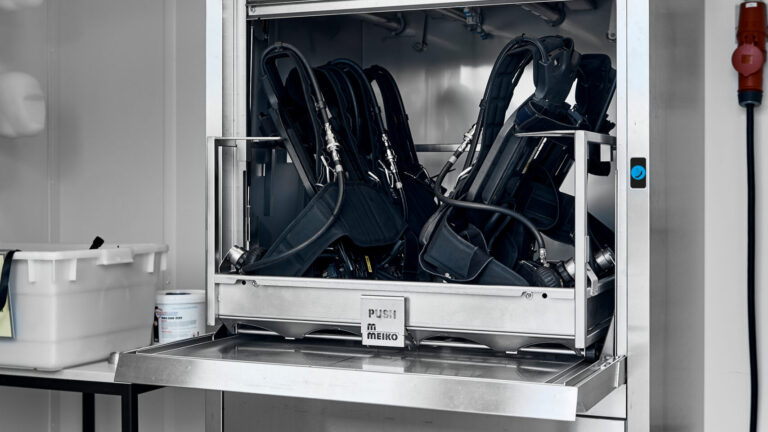
The first stage focuses on thorough pre-cleaning. Complete SCBA harnesses – including regulators and cylinders – are loaded into the TopClean D PPE decon machine. Up to four units can be processed simultaneously.
- Programme flexibility:
-Light soiling: approximately four minutes.
-Moderate soiling: approximately eight minutes.
-Heavy soiling: up to 16 minutes.
- Compressed air connection prevents moisture from getting into regulators.
- Closed system minimises operator exposure to contaminants and cleaning aerosols.
SCBA masks are mounted on plastic heads and cleaned externally. This ensures that hazardous residues are removed from the outside without contaminating the inside of the masks.
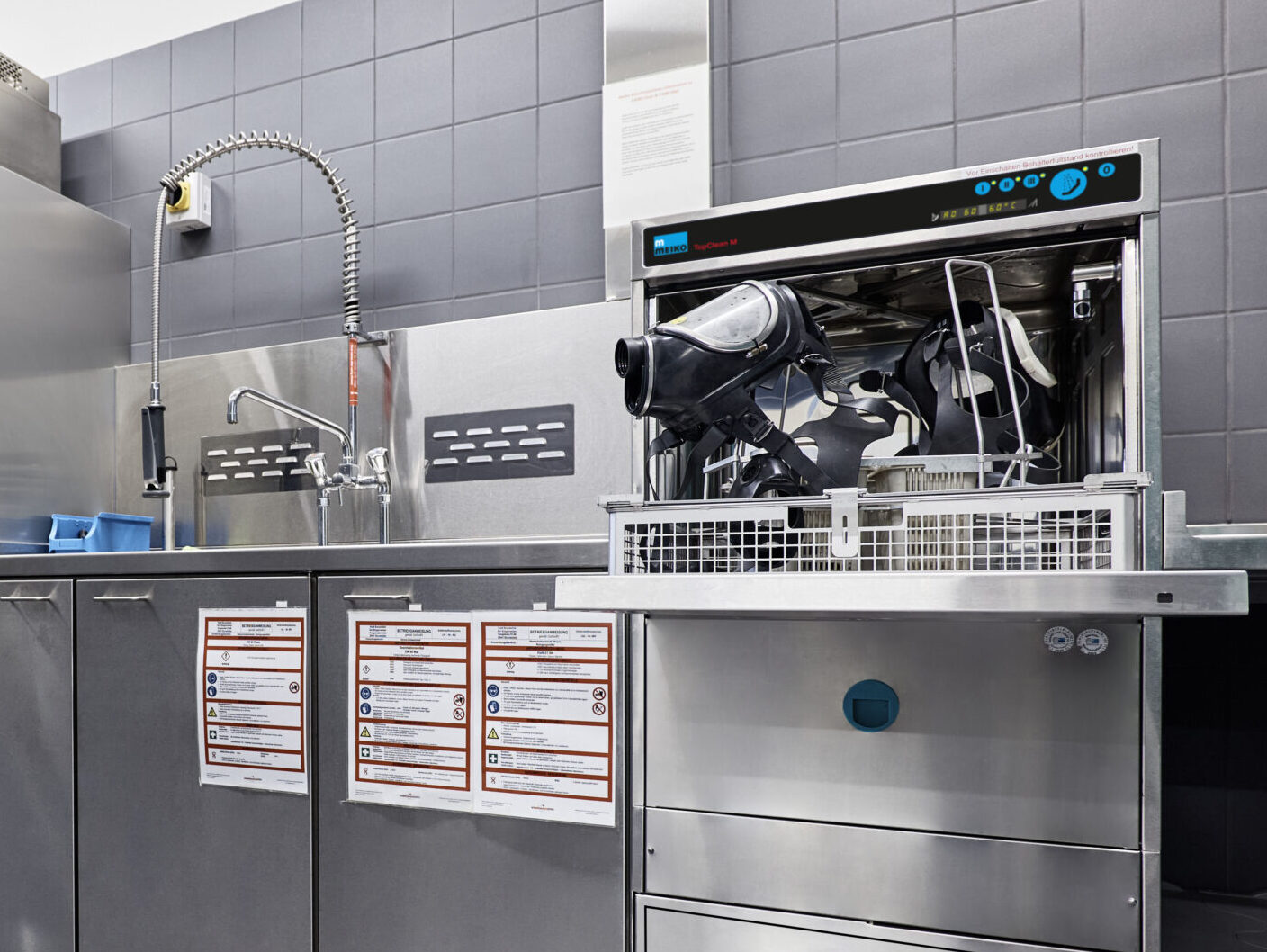
Step two: cleaning and disinfection with TopClean M
Following pre-cleaning, the masks are disassembled. Components are sorted into racks and transferred to the TopClean M cleaning and disinfection machine.
Here, the process delivers intensive cleaning and disinfection inside and out:
- Dedicated racks for masks and small parts ensure optimal cleaning.
- Disinfection provides hygienic safety.
- Simultaneous processing of multiple masks increases throughput.
This second step ensures compliance with hygiene requirements while preparing equipment for safe reuse.
Designed for occupational safety
A key focus of the workshop is minimising direct contact with hazardous substances. Firefighters’ PPE, particularly respiratory equipment, can carry carcinogenic and toxic residues. The automated two-step process prevents contact with harmful vapours that arise during manual cleaning procedures.
Combined with the physical separation of clean and dirty zones, the result is a workflow that prioritises operator safety at every stage.
Measurable gains in efficiency
The integration of TopClean D and TopClean M has led to a noticeable increase in productivity:
- Simultaneous processing of multiple SCBA sets.
- Reduced manual labour.
- Smoother workflow in the wet area.
- Significant time savings – particularly when handling larger volumes of PPE.
For SCBA technicians, this means less physical strain and more predictable, repeatable processes.
Planning as the foundation
The workshop’s success is rooted in early, collaborative planning. Involving fire service users, planners and technology providers from the outset ensured that operational needs, safety requirements and workflow efficiency were fully aligned, resulting in a modern SCBA workshop with optimised processes and reliable performance.