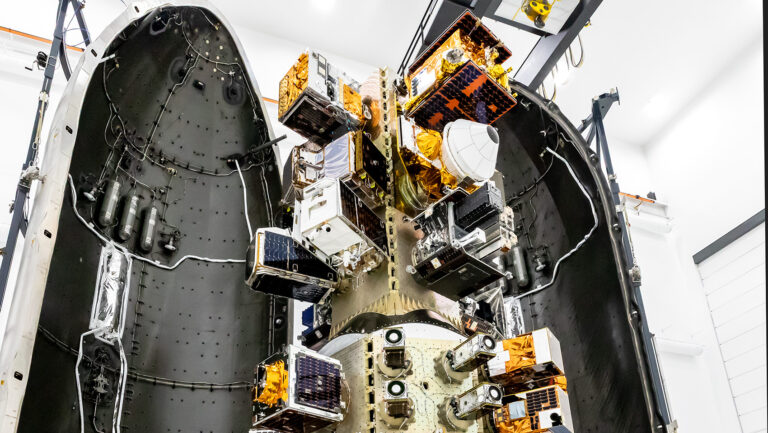
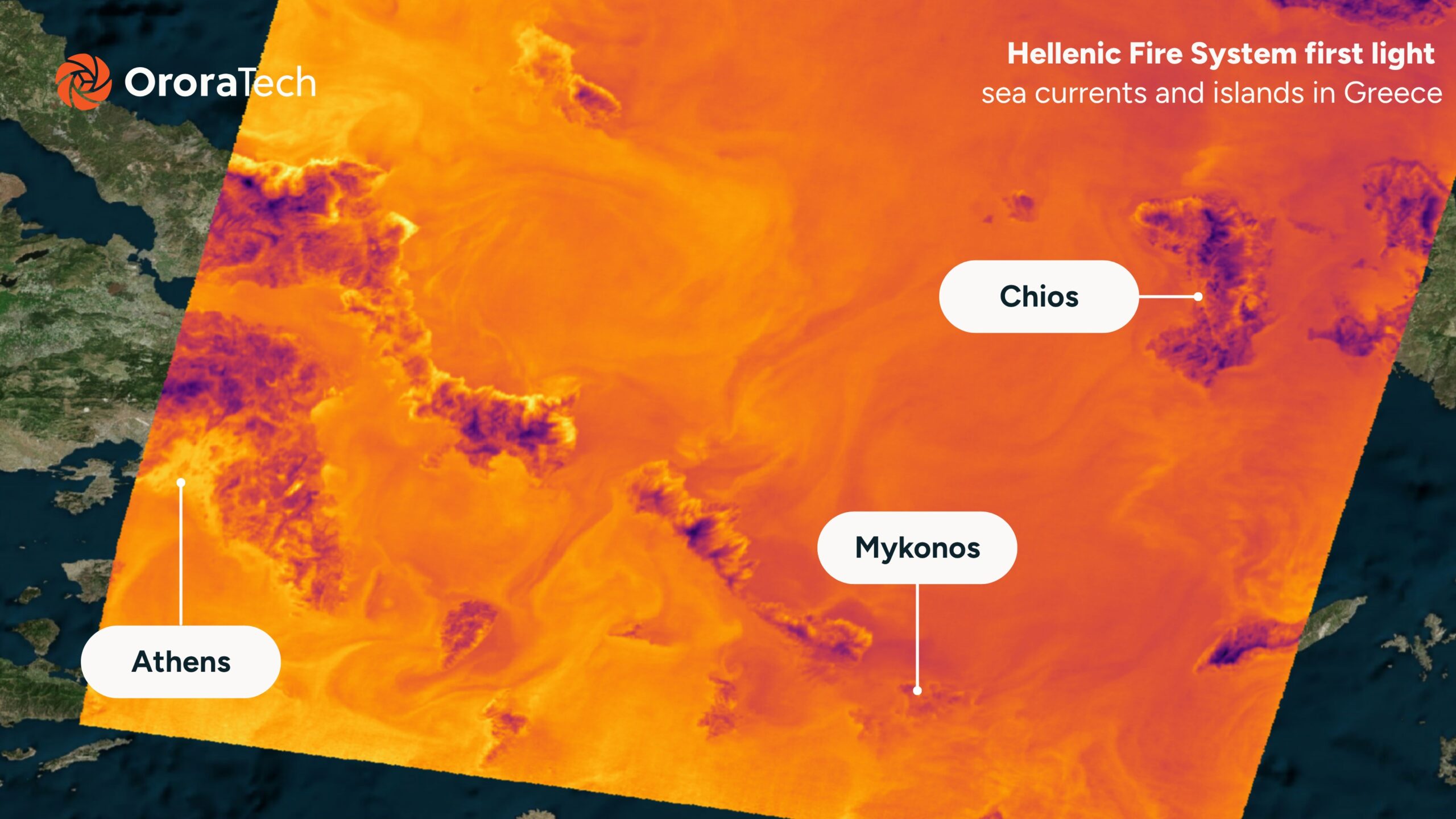

OroraTech has announced that the Hellenic Fire System has successfully achieved first light less than one month after satellite launch, capturing its first thermal image over Greece and marking a significant milestone in the country’s future national wildfire monitoring capability.
Captured in less than a month after launch and following commissioning activities, the first image demonstrates the rapid deployment and operational readiness of OroraTech’s thermal sensing technology.
Preceded by two weeks of imaging calibration, the first thermal image reveals the heat signature of the Athens metropolitan area, together with the islands of Andros, Tinos, Skyros, Chios, Kea and Kythnos.
The image also captures thermal patterns created by swirling currents across the Aegean Sea.
According to OroraTech, the achievement validates both the spacecraft’s performance and the engineering heritage behind its thermal sensing systems.
The sensors are designed to deliver highly accurate land surface temperature measurements and wildfire detection capabilities from low Earth orbit, while providing low latency and frequent revisit rates.
Supporting national wildfire resilience
The Hellenic Fire System is being developed as part of Greece’s national investment in space-based wildfire resilience.
Once fully operational, the satellite constellation will scan the entire country twice each day, providing continuous thermal monitoring to support wildfire detection, emergency response and climate research.
In addition to wildfire monitoring, the system will generate land surface temperature data to support scientists and researchers studying environmental change across the Mediterranean.
OroraTech said the successful first-light image confirms the system’s ability to observe both land and maritime thermal phenomena, demonstrating its suitability for a broad range of operational and scientific applications.
European partnership
The Hellenic Fire System is being delivered under a European Space Agency (ESA) contract as part of the Greek National Satellite Space Project.
The Small-Satellites project (Measure ID 16855) is being implemented by the Hellenic Ministry of Digital Governance and Artificial Intelligence with ESA providing management and implementation support.
The initiative forms part of Greece’s National Recovery and Resilience Plan, Greece 2.0, which is funded through the European Union’s Recovery and Resilience Facility under the NextGenerationEU programme.
Martin Langer, CEO of OroraTech, said: “Achieving first light so quickly demonstrates the maturity of our technology and the exceptional work of our engineering teams.
“We have spent years refining thermal sensing systems that deliver both unmatched image quality and operational performance. This milestone shows our ability to rapidly bring sophisticated space assets into service while providing the high-quality thermal data needed for wildfire detection, environmental monitoring, and scientific research.”