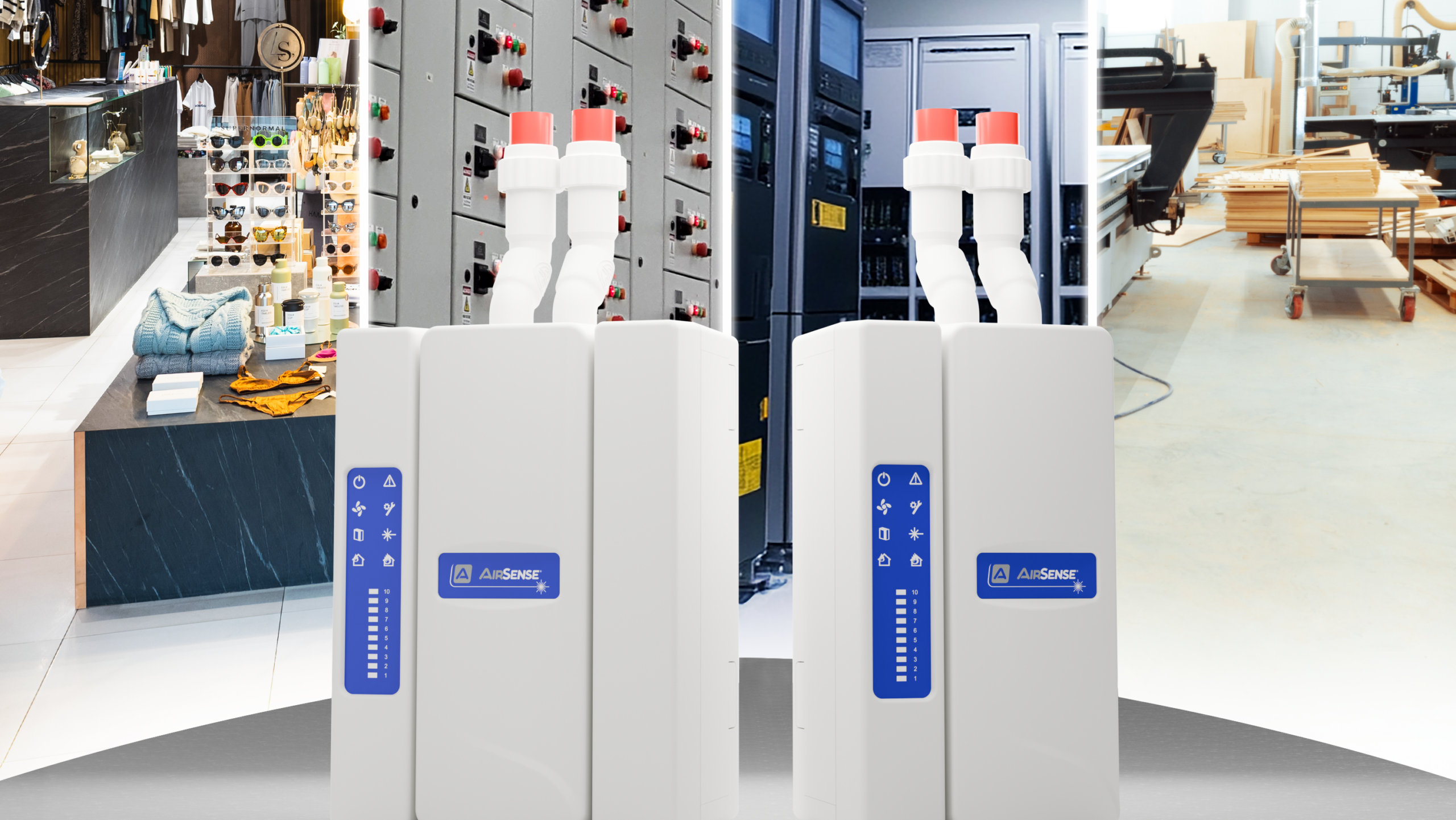
Kidde MiniLaser is an aspirating smoke detector designed to identify smoke particles at an early stage. Rather than waiting for smoke to reach a ceiling mounted detector, MiniLaser draws air from the protected area through narrow pipes and analyses it within the unit using laser detection.
This approach is particularly suited to challenging environments including high ceiling spaces, areas with strong airflow, cold stores and dusty locations. It can also support applications where conventional detectors are difficult to access or need to remain out of sight.
ClassiFire technology adapts detection to its environment
At the centre of MiniLaser is ClassiFire, a patented algorithm developed by AirSense. The technology measures normal environmental conditions during its first 15 minutes of operation and refines this understanding over 24 hours. Alarm thresholds then adapt to changing conditions, including shifts in occupancy, seasonal changes and accumulated dust.
Laser dust discrimination distinguishes the sharp spikes produced by dust from the steadier increase associated with smoke, helping reduce unwanted alarms.
MiniLaser operates across a sensitivity range of 0.005 to 20 percent obscuration per metre and is certified to EN 54 20 Classes A, B and C.
Simplifying installation and maintenance
A single MiniLaser supports up to 125 metres of pipe, 35 sampling holes and an area of 1,600 square metres.
Wiring is installed into a clip in base before the detector is unpacked, while tool free connectors can save approximately 30 minutes during each installation. An airflow balancing assistant supports commissioning calculations.
Simple systems can be configured using DIP switches, while complex designs can use PipeCAD. The design file is stored within the detector for future servicing.
A waste gate directs 90 percent of sampled air past the filter, helping extend filter life and increase intervals between service visits.