

As energy storage and electrification expand, fire suppression is evolving through strategies designed to prevent, control and manage lithium-ion risks.
Lithium-ion batteries have shifted fire risk from a relatively familiar problem, surface flames and fuel load, to a more complex failure mode that can be self sustaining, fast escalating and difficult to extinguish. As battery energy storage systems (BESS) expand to support renewables, and as electrification moves into transport, ports, logistics and heavy equipment, suppression is being forced to evolve. Those in the industry are increasingly asking a blunt question: what actually works, in the real world, when a cell fails and thermal runaway starts?
The honest answer is that there is no single universal ‘best’ suppression method. Battery incidents are multi-phase events that can include off-gassing, jet flames, heat release, re-ignition, toxic by-products and, in some configurations, explosion risk.
Strategy is now layered. Prevention and early intervention sit alongside containment, cooling, controlled burn-down, and post-event management. Suppression selection, therefore, is becoming about objectives as much as equipment.
Why Lithium-Ion Changes the Suppression Problem
A lithium-ion battery fire is not simply a conventional Class A or Class B event relocated into a container. Thermal runaway can propagate cell-to-cell and module-to-module. Even where flames are knocked down, residual heat and ongoing chemical reactions can drive re-ignition. Industry guidance continues to stress the scale of water demand often required to control large arrays and the need to think in terms of control and containment rather than instant extinguishment.
This is the context in which innovation is happening. Some technologies aim to stop fire growth in an enclosure and buy time. Others focus on interrupting flame chemistry, reducing heat release and limiting propagation. Others are designed to deliver sustained cooling or to support incident management with reliable water supply, proportioning and application hardware.
Moving From Suppression to Prevention
A noticeable trend is the growth of systems designed to act before thermal runaway becomes a full fire. Johnson Controls has formalised this approach with its Lithium-Ion Risk Prevention System, which is designed to continuously monitor batteries for off-gases associated with early cell malfunction, prior to thermal runaway. This matters because it reshapes what ‘suppression’ means in a BESS context. If the system can provide credible early warning and automated mitigation actions, such as shutdown and ventilation control, then fixed suppression can be tasked more realistically with controlling an incipient fire rather than being expected to stop a fully developed runaway event.
For International Fire Buyer readers, the procurement implication is clear. When evaluating suppression for BESS, ask whether the solution starts at prevention, moves through early intervention, and ends with a defensible plan for containment and cooling. Buyers who only compare extinguishing agents risk missing the bigger risk management architecture.
Condensed Aerosol as an Enclosure-Focused Tool
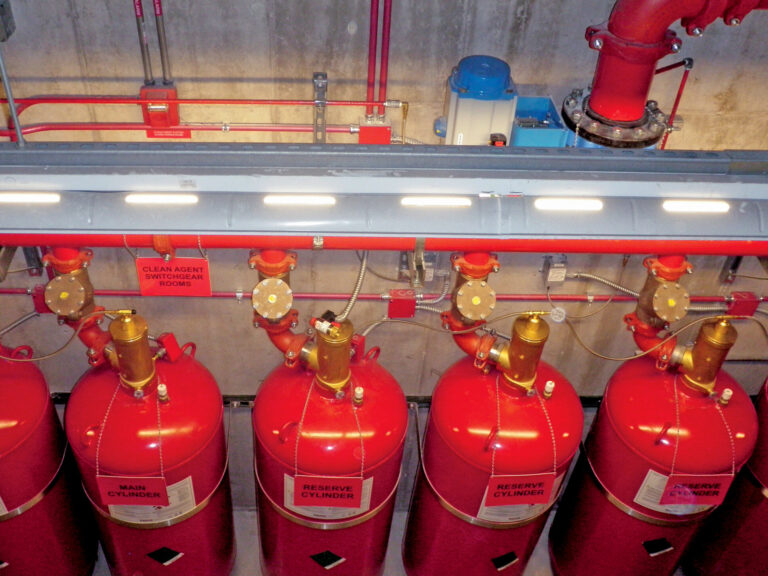
Condensed aerosol suppression has gained visibility in battery storage because it can be deployed inside enclosures and containers without large cylinders, complex pipework or significant space penalty. FirePro positions its condensed aerosol technology as proven through extensive testing for suppressing lithium-ion battery fires and limiting propagation to adjacent packs, with applications explicitly including energy storage systems. FirePro also explains the suppression mechanism as interrupting chemical chain reactions in the flame rather than relying on oxygen depletion.
TO READ THE FULL ARTICLE READ THE LATEST ISSUE HERE.