International Fire Buyer speaks with Fred Hildebrandt, Sales Director at Janus Fire Systems, on engineered suppression solutions for emerging high-risk environments
As fire risk profiles continue to evolve across global industry, traditional suppression strategies are being tested by new hazards. Energy storage systems, automated warehousing, high hazard manufacturing, and mission critical infrastructure now demand faster response, greater system reliability, and stronger environmental accountability.
In this Ask the Expert feature, Janus Fire Systems examines how clean agent and specialised suppression technologies are adapting to these challenges, and what designers, operators, and regulators must consider as fire protection enters a more complex and interconnected era.
How is the demand for clean agent and specialised suppression systems evolving as industries face new fire risks?
Each market sector presents its own distinct risk profile, operational priorities, and tolerance for system disruption. An automated warehouse, for example, introduces fire scenarios driven by high rack storage, limited human presence, and rapid fire spread, while energy storage systems introduce complex thermal runaway risks and re ignition potential. High hazard industrial environments may combine flammable materials, confined spaces, and continuous operations where downtime is not an option.
What ties all of these environments together is the growing requirement for fire protection systems that are engineered rather than generic. Clean agent and specialised suppression systems are increasingly being selected not only for their extinguishing capability, but for their ability to protect assets while maintaining business continuity.
At the core of this evolution is detection. No suppression system can perform effectively without a properly designed detection scheme. This means using detection technologies that are appropriate to the hazard, and control panels capable of integrating advanced detection methods, including aspirating systems, multi criteria detection, and early warning technologies.
Industries are no longer willing to accept delayed response or blanket protection strategies. They are demanding systems that respond quickly, act locally, and integrate seamlessly with operational processes. This shift is driving increased adoption of engineered clean agent systems that are specifically tailored to the hazard rather than adapted after the fact.
What recent innovations within Janus Fire Systems’ suppression portfolio have had the greatest impact?
Special hazard fire suppression systems exist for one primary reason: to protect life, assets, and operations without causing unnecessary interruption. At Janus, our approach has always been rooted in engineered solutions that support business continuity rather than simply meeting minimum protection requirements.
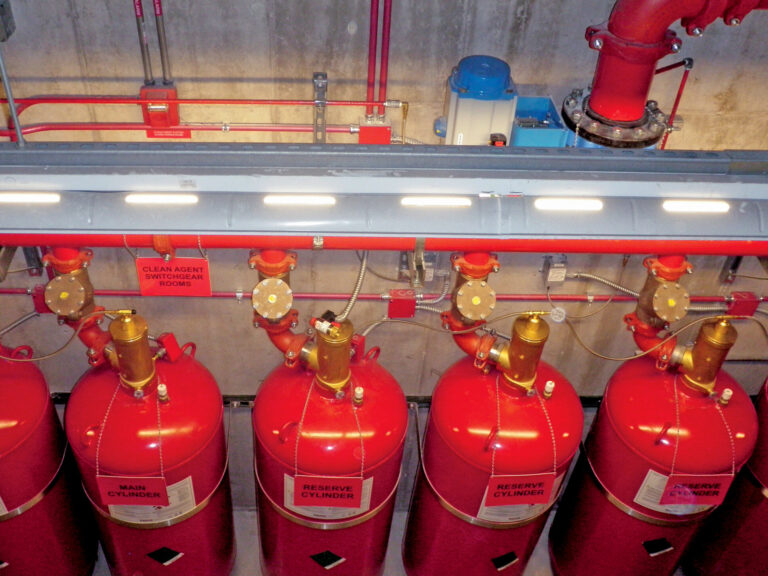
One of the most significant developments within our portfolio has been the expansion of our clean agent offering to include IG 100 inert gas systems, using nitrogen as the extinguishing medium. This addition provides designers and distributors with greater flexibility when selecting the most appropriate suppression solution for a given risk.
Inert gas systems such as IG 100 offer predictable performance, minimal environmental impact, and high reliability when properly engineered. By expanding our portfolio to include this technology, we have been able to address a wider range of applications while maintaining consistent design philosophy and system integrity.
Reliability is not only about the agent itself. It is also about system architecture, component quality, and installation discipline. Our focus on engineered solutions ensures that response times, discharge characteristics, and system performance are clearly defined at the design stage, reducing the likelihood of operational surprises during an actual event.
How is Janus approaching sustainability, agent selection, and lifecycle impact?
Environmental responsibility has been a central consideration at Janus since our inception in 2008. Our management team recognised early on that fire protection could not exist in isolation from broader environmental and regulatory pressures.
This awareness directly influenced our decision to adopt IG 100 nitrogen as our primary inert gas offering. Nitrogen is naturally occurring, has zero ozone depletion potential, and zero global warming potential. From an environmental standpoint, it represents one of the most responsible choices available within gaseous fire suppression.
Beyond agent selection, sustainability must be considered across the entire system lifecycle. This includes system longevity, maintenance requirements, component replacement intervals, and end of life considerations. Engineered systems that are correctly designed and installed tend to have longer service lives and lower total environmental impact than systems that require frequent modification or replacement.
As global environmental regulations continue to tighten, we expect lifecycle accountability to play an even greater role in suppression system selection, particularly in data centres, energy infrastructure, and industrial facilities with corporate sustainability commitments.
TO READ THE FULL ARTICLE SEE OUR LATEST ISSUE HERE