

Ed Hill analyses how data centre operators balance the need for uninterrupted uptime with the realities of modern fire risk and engineering reliable suppression systems
There are only a few environments where a few seconds of downtime can cost millions, and a few minutes can bring down half the internet. However, data centres belong to that rare club. They do not sleep, they do not tolerate interruptions, and they don’t withstand surprises. Yet fire still sits uncomfortably close to the heart of the digital world.
When operators discuss fire protection in data centres, what they are really discussing is continuity. Suppression must work instantly, quietly, precisely, and with no implications of damaging the very systems it is trying to save.
This is where engineering ambition meets operational anxiety, and where companies across the sector are pushing suppression design into necessary territory.
When Uptime Is Non-Negotiable
Every data centre operator will give the same answer when asked about their tolerance for downtime – there isn’t any. That single expectation drives almost every design decision.
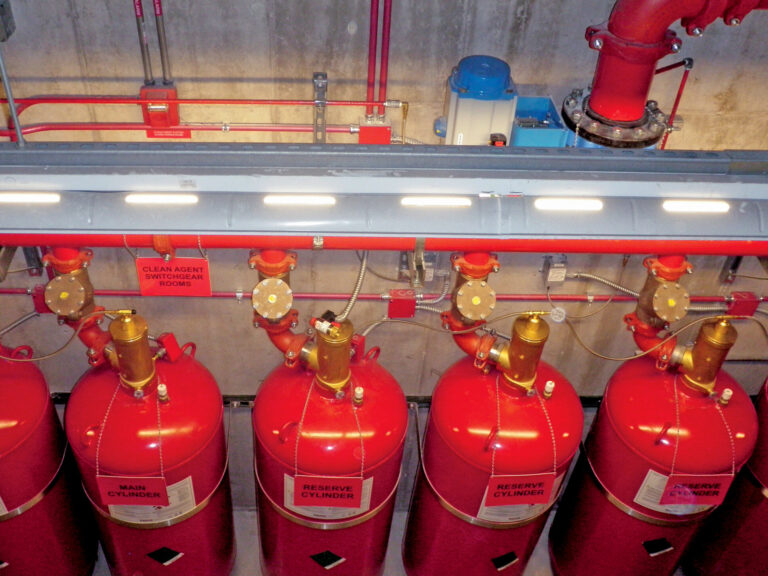
Clean agent and watermist systems became popular precisely because traditional sprinklers look a little too archaic for rooms full of high value servers. However, the shift was not about fashion but about risk. Water has always been an excellent suppressor, but data centres do not allow the luxury of post incident drying. They expect systems to keep running while the fire protection does its job in the background. This has led to a generation of engineered suppression systems that must behave like precision tools rather than blunt instruments.
Companies such as Johnson Controls, with its long history in engineered suppression design, have become central to the discussion. Their work in advanced clean agent systems and integrated detection networks reflects a broader trend. Operators want suppression that activates only when necessary, targets the right compartment with accuracy, and does not require a shutdown to deal with the consequences. What once sounded like a wish list is now a baseline expectation.
The Heat Problem
Data centres generate heat at levels that would have been unthinkable a decade ago. High density racks, liquid cooling loops, and lithium-ion UPS installations have introduced energy profiles that behave in inconvenient ways. Failures can escalate quickly. This is why detection speed matters as much as suppression capability.
Hochiki is one of the manufacturers that has long understood this. Their aspirating systems and intelligent point detectors are designed to contend with airflows that refuse to behave. Data centres are not calm environments. They are full of turbulence, temperature gradients, and pressure differentials created by powerful HVAC systems. In these conditions, smoke moves unpredictably. Hochiki’s systems attempt to read these patterns, not fight them.
Linesense approaches the challenge from a different angle. Their linear heat sensing cable does not care about airflow at all. It sits in cable trays, containment runs, and ceiling voids waiting for a temperature excursion. For data centres that worry about the hidden places where fires start, this type of detection brings a certain comfort. It is engineering built on the idea that sometimes the best sensor is the one that never moves.
Securiton, with its reputation for very early warning smoke detection, arguably plays in the most demanding piece of the puzzle. The earlier a fire is spotted, the more gracefully a data centre can respond. Securiton’s systems are often found in facilities that refuse to entertain even the slightest operational risk. If detection is a race, they specialise in finishing it before it has begun.
TO READ THE FULL ARTICLE SEE THE LATEST ISSUE HERE