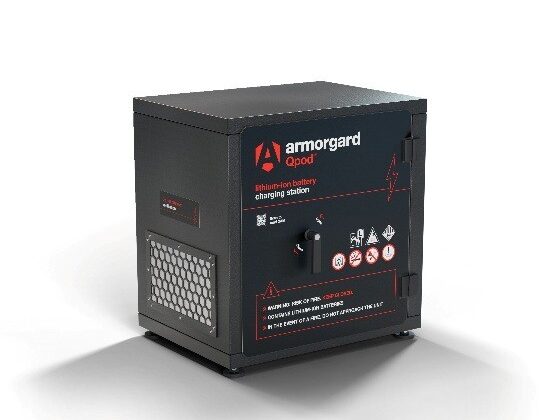

Armorgard has launched Qpod, a compact lithium ion battery charging and storage cabinet designed to improve indoor battery safety across warehouses, manufacturing facilities, retail environments and offices.
The UK manufacturer said Qpod has been developed in response to the sharp rise in lithium ion battery fires, which are costing UK businesses millions of pounds each year.
Recent research from Aviva found that 54% of businesses surveyed have experienced a lithium-ion fire or related incident, while London Fire Brigade attended more than 5,000 lithium ion-related callouts during 2024, representing a 93% increase since 2022.
With McKinsey forecasting a 33% growth in lithium ion-powered devices over the next decade, Armorgard said demand for safe indoor charging and storage solutions is expected to continue increasing.
Compact design with enhanced protection
Designed as a plug-and-play charging and storage solution, Qpod incorporates Armorgard’s proprietary fire-tested containment system, which has been validated against real thermal runaway events.
Constructed from powder-coated steel, the cabinet provides 240V charging and has been designed to meet a range of internationally recognised standards, including UL1487.
It features a sealed, double-walled ventilation system that safely expels gases while preventing flames from reigniting toxic gases outside the cabinet.
Its compact footprint allows the unit to fit beneath desks or into corners where space is limited. Weighing 74kg, Qpod can be relocated easily and is available with optional castors.
High-capacity charging
Inside the cabinet are eight 13A RCD-protected sockets, enabling up to eight lithium ion batteries to be charged simultaneously.
For organisations with larger battery fleets, Armorgard also offers a stacking kit, allowing multiple Qpod units to be securely installed vertically to maximise available floor space.
Tested for real-world conditions
Armorgard said Qpod has undergone extensive UK-based testing throughout its development, building on the validation programme used for its Volthub battery storage range.
Unlike many indoor charging cabinets tested only under laboratory bench conditions, Qpod’s double-walled containment system has been tested during controlled thermal runaway events involving batteries exceeding 2kWh, above the cabinet’s intended charging capacity of 1.5kWh.
Supporting insurance compliance
The company said the testing is increasingly important as insurers place greater scrutiny on lithium ion battery charging arrangements.
According to Armorgard, non-compliant charging practices can lead to higher insurance premiums, policy exclusions or difficulties obtaining cover.
The company says specifying Qpod allows organisations to demonstrate they have taken practical, evidence-based measures to manage the recognised workplace risks associated with lithium-ion batteries.
Terry Mitchell, Armorgard CEO, says: “Li-ion batteries are incredibly useful, but they’re also hazardous if charged or stored incorrectly.
“The last decade has seen rapid adoption alongside a sharp rise in faults, failures and fires, largely through mishandling.
“Anyone who’s experienced one of these incidents will tell you of the enormous human, financial and reputational cost involved.”
“Qpod is the direct evolution of our VoltHub and PowerStor cabinets, answering the growing use of Li-ion batteries in smaller, often interior, spaces.
“We’ve made sure that neither safety nor performance is compromised, delivering plenty of charge without disrupting day-to-day operations.”