Modern fire fighting truck in city - Fire Buyer

Commitment to excellence since 1963

At the start of a new decade and after close to fifty years, Paratech Incorporated has been proudly designing and manufacturing all of their rescue equipment in the United States. As an ISO 9001 certified company since 1998, Paratech continues to lead the world in the design and production of innovative lifesaving emergency equipment. Their pioneering spirit, continuous product development and commitment to excellence have been the cornerstone of Paratech’s vision since 1963. A combination of cutting edge manufacturing technology and focus on reallife usability has made Paratech’s equipment the standard for disaster agencies’ rescue teams and technical rescue caches both in the U.S. and internationally. Paratech products are extensively used by fire departments worldwide including, but not limited to, all major U.S. cities, Copenhagen, Tokyo, London, Lyon, Madrid, Singapore, Denmark, Japan, UK, to name a few. Paratech’s equipment has been deployed to assist in major disasters such as the 1994 Northridge, CA earthquake; 1995 Kobe, Japan earthquake; 1999 Istanbul, Turkey earthquake; 2005 New Orleans, LA Hurricane Katrina; 2001 New York World Trade Center attack; 2007 China earthquake; 2009 L’Aquila, Italy earthquake, 2010 Haiti earthquake. Paratech’s product lines are comprised of: Rescue Support Systems (RSS) – Structural collapse emergencies occur almost daily somewhere in the world and they are easily one of the most difficult challenges faced by fire brigades and rescue teams. “Workmen Trapped During Building Demolition”, “Natural Gas Explosion”, “Terrorist Bomb”, “Earthquakes Affects Residential Area”, “Burning Building Collapse Traps Fire Fighters”. Paratech’s Rescue Support Systems are the strongest and most versatile struts in the world and have been FEMA tested and adopted as standard for their technical caches. Paratech’s Rescue Support Systems are used for: Structural collapse – Earthquakes, construction collapses, cave-ins, floods and structural fire damage require a collapse rescue system designed to extract victims in a safe and timely manner. ‘Paratech manufactures all of its major control components to assure the quality of the lifting bag system from inflation to deflation.’ Excavation containment – Paratech’s pneumatic rescue struts allow for remote placement and easy locking as well as safe, remote removal. Special Applications – A wide variety of bases and accessories are available to assist in numerous special application scenarios and are used in combination with Paratech’s LongShores, AcmeThread and LockStroke struts. These include, but in no way are limited to, elevator shaft access and victim retrieval, high angle applications, confined space work and trench rescue scenarios. Vehicle Stabilisation – Paratech’s Vehicle Stabilization Kits (VSKs) have the strength and flexibility to handle sub compact cars, buses, cement trucks and even train locomotives. Additionally, these components provide the extra value of being changeable with the other Paratech Equipment for building collapse and trench rescue scenarios. Depending on the Kit, Paratech’s Vehicle Stabilization Kits have a load capacity of up to 120,000 lbs. (54,431.1 kg) with a 4 to 1 safety factor. MAXIFORCE® Air Lifting Bags – Paratech offers a complete system comprised of 25 different sizes of Air Lifting Bags with the power to lift or shift up to 70 tons and all the control equipment to match. These bags, made from Neoprene covered aramid reinforcement are sold worldwide to fire departments, brigades and rescue teams. Paratech manufactures all of its major control components to assure the quality of the lifting bag system from inflation to deflation. All accessories used with the air lifting bags such as regulators, control valves, couplings, etc. are also manufactured at Paratech. Each bag is subjected to stringent factory pressure tests to assure maximum operator safety and the bags meet and exceed the intent of all known, recognised and published international standards for design, production and use of air lifting bags. These standards and listings include : National Coal Board (UK); NATO Stock Listings; National Defense Supply Listing (US); Department of Industrial Relations (AU); Japan Standards Institute (JA); GSA Contract Item (US). ‘Paratech is an environmentally conscious manufacturer that believes in saving valuable resources and minimising waste and pollution through advanced manufacturing systems.’ Powered Impact Tools – Paratech’s Powered Impact Tools (PIT) are designed for forcible entry. The three distinct models of pneumatic breakers (Airgun 40SC, Airgun 40, Pakhammer 90), are designed specifically for confined space operations and are engineered to be very rugged, ergonomic and lightweight. Paratech’s PITs have the ability to break and cut through concrete, masonry walls, steel, metal and composites, aircraft fuselages and are often used for digging during tunneling operations. The equipment provides maximum power with minimum air consumption. They are capable of being operated from portable air tanks such as breathing air cylinders, commonly carried by every fire department and rescue squad. The Paratech AIRGUN 40 is used by the U.S. Navy as part of the Navy’s shipboard rescue equipment. Forcible Entry Tools – These high quality heavy duty Forcible Entry Tools (FET) are designed to pry, pound, puncture, twist, cut open or remove all types of barriers between emergency personnel and the life they are saving. The category includes a full line of Hooligan Tools as well as a powerful Percussive Rescue Tool (PRT), the compact and versatile Pry Axe and the very popular Buster Tool. Tactical Forcible Entry Tools (TFE) -Targeting the tactical market, Paratech has customised its Forcible Entry Tools to cater to S.W.A.T. police, special operations and military forces. Made with a durable black tactical finish, these high quality tools are designed to pry, pound, puncture, twist, cut open and remove all types of barriers. Firefighting Tools (FFT) – Paratech manufactures a wide range of standard, essential, heavy duty overhaul tools. These rugged tools are made with the highest quality materials and are available in a range of sizes and configurations with lengths of 3′ to 12′ and custom lengths by special order. Rescue Air Cushions – These cushions (RAC) are an ideal tool for high lift requirements of non-reinforced broad surfaces on trucks, vans and light aircraft. Cushions are also used by collapse rescue teams to fill voids and regain support for rescue struts, wall braces and shoring. Other applications include

Commitment to excellence since 1963 Read More »

Firefighting foam being sprayed from fire hose - Fire Buyer

Ostrava Airport receives a new PANTHER 6×6.

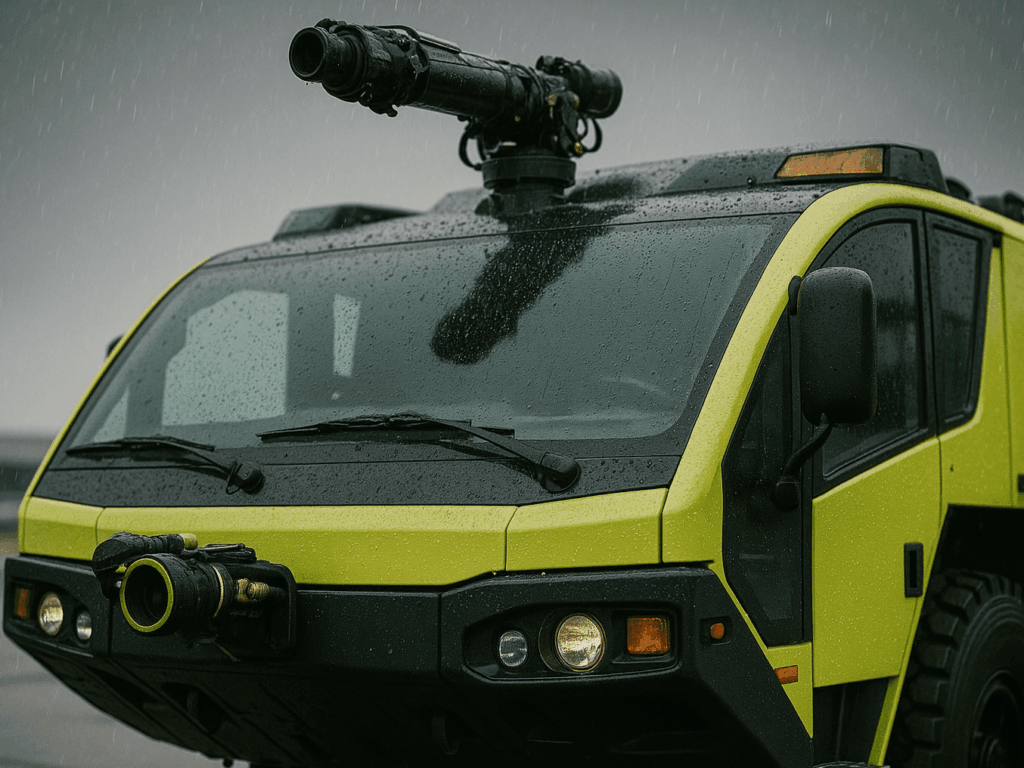
An unusual PANTHER from a technical and colour scheme perspective is supplied to Ostrava Airport At the beginning of February, ROSENBAUER, the world market leader in the special fire services vehicle field, supplied an unusual PANTHER to Ostrava, the largest regional airport in the Czech Republic. Ostrava Airport is situated 20 km to the south of Ostrava, which is the Czech Republic’s third largest city and in recent years has developed into a key air traffic centre due to a steady increase in passenger numbers. Today, the airport numbers among the most important development partners for the entire Moravia-Silesia region. The airport’s vehicle fleet is currently being updated within the framework of a modernisation programme and in addition to the new PANTHER, a double cabin BUFFALO from ROSENBAUER has been in use at the airport since 2006. Indeed, customer satisfaction with this vehicle is one reason why ROSENBAUER has been able to capture further vehicle delivery orders within the scope of the equipment upgrading programme. PANTHER 6×6 CA5 The chassis of the PANTHER is fitted with a Caterpillar C18 Euro 3 engine. With 705 hp, this accelerates the PANTHER from 0-80 kph within 30 seconds. The vehicle also disposes over all-wheel drive, two-circuit compressed air brakes and ABS in line with ECE R13 stipulations. Moreover, in spite of a dead weight of over 36t, it still reaches an impressive top speed of 115 kph. ‘Unusual from a technical and colour scheme perspective Ostrava Airport has recieved the one, and to date, only PANTHER with a livery in special RAL 3024 daylight fluorescent paint.’ The PANTHER 6×6 CA5 represents a reliable partner for fire-fighting at the airport. 12,500 l of water and up to 1,500 l of foam can be carried in its tanks. A Power Divider pump drive ensures mobile extinguishing and hence pump & roll operation. The R600 normal pressure pump has an output of 6,200 l/min at 11 bar, while the high-pressure pump emits 400 l/min at 40 bar. The powder unit, which has a pressure outlet on both the left- and right-hand sides, is operated electro-pneumatically. In addition, an RM60C water-foam monitor is located on the vehicle roof, which is fitted with xenon searchlights and has a capacity of 4,750 l/min at 10 bar. This high-performance monitor offers top figures with regard to throw range, which amounts to some 80 m. The front RM15C monitor with foam branch pipe emits 1,500 l/min and has a throw range of 60m. The simple control of both monitors permits one-hand operation by means of a joystick, which is used for the direct control of all monitor functions. Unusual from a technical and colour scheme perspective Ostrava Airport has received the one, and to date, only PANTHER with a livery in special RAL 3024 daylight fluorescent paint. Another new feature is the ergonomic positioning of the controls for the operation of the RM60C and RM15C monitors, which for the first time have been integrated into the armrests of the operator’s seat. In addition, the vehicle is fitted with a quick start device, a 7x35W xenon Flexilight lighting mast, and an infrared camera with hard disk memory and monitor display. The PANTHER constitutes an internationally respected vehicle concept that is not only used in Ostrava, but also at Prague Airport. The Czech customer of long-standing values both the quality of the ROSENBAUER’s products and also the availability of individual vehicle design. Hence the fact, that another three vehicles are to be supplied in mid-2010. ROSENBAUER E8000/E3000 rescue stair vehicles for German airports In recent months, ROSENBAUER has equipped both Munich and Berlin Airport with new, mobile rescue stair vehicles. The vehicles involved represent a special, fire-fighting technology development for the rapid evacuation of aircraft passengers. Moreover, in the other direction, the staircases offer the emergency services (fire, rescue and medical personnel) safe access to the interior of the plane. The vehicles are based on original Mercedes-Benz and MAN chassis. Suitable for all standard types of aircraft The new ROSENBAUER rescue stair vehicles are suitable for all currently standard types of aircraft. An operational height of up to 8.30 m can be reached via the main stairs. This is the level of the emergency exits of the A380 and the Boeing 747, which at present are the world’s largest passenger aircraft. Upper rescue platform With a width of 3,000 mm, a depth of 2,800 mm and a loadbearing capacity of 320 kg/m2, the upper rescue platform offers sufficient security for the evacuation of the aircraft’s passengers and furnishes the rescue services safe and rapid access to the cabin. The high-performance hydraulics of the vehicles ensures that the main stairs can be completely run out from the storage position to their maximum height in approximately 70 seconds, which means that they are ready for operation in minimum time. Furthermore, a Level Control System (LCS) permits the preprogramming of the door heights of differing types of aircraft, thus allowing automatic docking in an emergency. A second rescue platform at the front, which can be mounted on the original superstructure of the vehicle, which was used for winter road services, covers heights between one and three meters. Top safety standards The main focus during the development of the new rescue stair vehicle was on safety in the case of an evacuation. Therefore, the width and depth of the stairs (1.500 mm / 390 mm) were selected to ensure that three persons are able to descend in comfort and side by side. Irrespective of the angle of the stairs, the steps are always in a horizontal position, which allows them to be used in safety. In order to provide a flush connection with the rump of the aircraft, the rescue stair vehicle comes to a halt at a distance of roughly 700-800 mm from the plane. The telescopic section (max. 1,000 mm) under the rescue platform then closes the remaining gap between the aircraft and the staircase in a horizontal direction, and thus adapts to the contour

Ostrava Airport receives a new PANTHER 6×6. Read More »

ARFF Vehicle image - Fire Buyer

Effective and safe

Firefighters need reliable communication to do their job effectively and safely. Interspiro was the first SCBA company to recognise this 40 years ago when the first mask-mounted radio interface was introduced. Now 40 years later, Interspiro introduce the latest innovation in firefighter communication: the SpiroCom, 3-mode wireless interface. For the first time, three modes of communication from one, wireless, mask-mounted unit is introduced. SpiroCom provides an integrated amplifier, full-duplex team talk, and digital radio interface, all in one mask mounted solution: • Voice Projection Amplifier, for general communication to those around you while you have your mask in place. • Team Talk, 16 channels of full duplex, open communication so you know what everyone on your team is doing, all the time. Team talk is on all the time, and operates hands-free, so staying in contact with your team is as easy as speaking. • Wireless Radio Interface for communication beyond the team, to report to incident command or communicate with other teams. The wireless interface is activated by a push to talk (PTT) switch on the side of the SpiroCom. When any SpiroCom on your team is linked to a digital radio, all members of your team will hear that radio traffic: coming and going. It’s like three layers of communication in one device. Radio traffic takes priority over team talk, but when the radio goes quiet, team talk is automatically restored. Team talk becomes your main backbone for communication with your team, but when talking to someone outside your team, the amplifier helps get your message across. What this means for you is a new way to think about communication: with your command organisation, with the other firefighters on your team, and with the trapped victim in a back bedroom. You need to communicate with each of them, but until SpiroCom that meant wires and separate hardware. Now, one wireless mask-mounted unit allows all three modes of communication. SpiroCom is a revolutionary step in communications that changes firefighting for the better. You get better situational awareness, as the team “chatter” reinforces your sense of where your team members are, and how they’re progressing. You also get a better sense of overall progress on the fire scene as digital radio traffic “trumps” your team talk with updates. Firefighting requires teamwork, and now you have a communication tool that recognises that, and supports that teamwork. SpiroCom is available only from Interspiro, for use with Interspiro masks and SCBAs. Interspiro is launching SpiroCom, in the spring 2010 trade shows at FDIC in Indianapolis and Interschutz in Leipzig. www.interspiro.com

Effective and safe Read More »

Modern British Fire alarm on wall - Fire Buyer

The University of Nevada Background

  The Fire Science Academy, a program of the University of Nevada, Reno (FSA), and an entity of the State of Nevada, is a professional institution specialising in the emergency preparedness and response needs of industry for over 35 years. Expertise includes reviewing emergency preparedness and response programs; safety management audits; developing and conducting tabletops, drills, and exercises; consultancy services; and training on site as well as at the one of a kind academy in Nevada, USA. Unique to the FSA is its prop field, using real liquid hydrocarbon fuels and real extinguishing agents, which allows responders to apply classroom theory in a realistic, hands-on training environment. The prop field is comprised of full-scale replicas of equipment and structures found in industry, such as refinery processing units, fuel storage tanks, gas and electric motors, valves, rail cars, and over the road trucks. Realistic emergencies, including air and rail disasters, hazardous materials releases, motor vehicle accidents, and processing plant fires, can all be simulated. Responders apply practical strategies and tactics in a team-based approach to mitigate the emergency. The FSA is playing an important role in preparing the world’s emergency responders. Whether an incident is the result of an industrial accident, natural disaster, or from terrorist activity, emergency response professionals receive leading edge instruction in a hands-on training environment. Few institutions are capable of offering the intense and realistic training characteristic of FSA programs, so valuable to response professionals. The Western Oil and Gas Association (now the Western States Petroleum Association), founded the Fire Protection Training Academy (FPTA) in 1972 as a fire school for the petroleum industry. Located in Stead, Nevada, the successful program was eventually donated to the University in 1984 as a revenue generating enterprise. By the early 1990’s the program had grown in size and scope and was eventually listed in the Occupational Safety and Health Administration (OSHA) regulations as an approved school for industrial fire brigade training. The Community of Stead also grew during this timeframe and the FPTA was deemed an “unwelcome” neighbour. Faced with closing the facility six months per year to maintain air quality, the University sought to relocate the program. Elko County, Nevada responded to the statewide request for proposal, donating the land for the construction of the new facility. Renamed the Fire Science Academy, the program relocated to its new campus in Elko County in 1999. ‘The Western Oil and Gas Association (now the Western States Petroleum Association), founded the Fire Protection Training Academy (FPTA) in 1972 as a fire school for the petroleum industry.’ Program Standards The FSA relies upon the guidance contained in a variety of regulatory and consensus standards, safety laws, and industry best practices to conduct its professional training and consulting services. The following list is not intended to be exhaustive and other standards not listed here may also apply: * API – American Petroleum Institute * EPA – United States Environmental Protection Agency * FAA – United States Federal Aviation Administration * MSHA – United Stated Department of Interior Mine Safety and Health Standards * NFPA – National Fire Protection Association * NIOSH – National Institute for Safety and Health * NTSB – National Transportation Safety Board * OSHA – United States Department of Interior Occupational Safety and Health Standards The FSA provides a variety of client-responsive programs and services in the following core subjects: * Industrial Fire Fighting * Aircraft Rescue and Fire Fighting (ARFF) * Hazardous Materials Response * Technical Rescue * Wildland Fire Fighting * Mine Rescue and Fire Fighting * Incident Command and Officer Development * Audits and Assessments * Consulting services * Emergency response training program support and recognition * Training facility development Courses and services are conducted at the FSA site, or at the client’s site – anywhere in the world. Programs may be customised to meet unique client needs. Most programs are certificate or certification based, 32 to 40 contact hours in length. Continuing Education Units (CEUs) from the University may be awarded for successful completion of many courses. The facility is designed to serve approximately 6,500 students per year. Capacity for off-site programs is potentially unlimited. ‘Unique to the FSA is its ability to simulate disasters using flammable liquid fuels.’ Primary Markets and Customer Base The petrochemical industry remains a solid contributor to program enrollments at the facility and includes large multinational corporations such as ConocoPhillips, ExxonMobil, BP, Valero Energy, Shell Oil, Chevron, Marathon Oil, Tesoro Petroleum and the Dow Chemical Company. Many Fortune 500 companies utilise the FSA’s services and other industry sectors served include mining, power generation and distribution, pharmaceuticals, airports, manufacturing and government. More than 3,000 municipal, volunteer and rural emergency responders from the United States have also been served during the past four years. Funded through a grant from the U.S. Department of Energy, participants attended a highly specialised course to educate public sector responders on countering flammable liquid emergencies with emphasis on terrorist caused events. Props Approximately 21 different props are used to simulate handson training exercises. Comprised of structural steel, pipe, tanks, pumps, valves and fittings, the props create full scale replicas of disasters involving: * Airplanes * Industrial plants * Mining operations * Railcars and truck loading facilities * Underground sewer operations and other confined spaces * Fuel storage facilities & pipeline operations Unique to the FSA is its ability to simulate disasters using flammable liquid fuels. The fuels create realistic fire situations with the characteristics that would be encountered in a real event. The participants are placed in a true environment in which to perform and perfect the skills learned. The FSA is one of only two facilities in the United States that burn liquid fuels on this scale, creating the realistic environment associated with excellent training programs. Additionally, the FSA is an environmentally sound operation as unannounced regulatory inspections with no reportable findings have confirmed. FSA Worldwide FSA Worldwide is the outreach unit of the FSA providing programs and services to clients at locations around the world. Nearly

The University of Nevada Background Read More »

Scroll to Top