Chief Michael Young's has been elected as Chair of the NFPA Fire and Emergency Services member section. firebuyer.com

Michael Young elected chair of NFPA member section

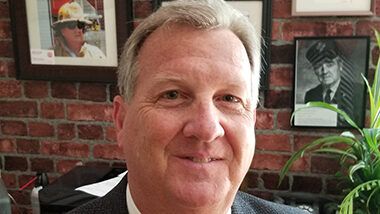
Chief Michael Young has been elected chair of the National Fire Protection Association (NFPA) Fire and Emergency Services member section. Young will serve a two year term after being elected by NFPA section members. 36 years in public safety Young began his public safety career 36 years ago as a call firefighter and EMT Paramedic before spending 33 years with Plymouth Fire Department. He progressed through the ranks of lieutenant, captain and battalion chief before becoming deputy fire chief. In that position, Young was responsible for operations involving more than 120 uniformed personnel across seven fire stations, alongside six civilian employees and two Emergency Management Division employees. The department responded to more than 7,300 emergency incidents annually. Young also undertook fire suppression and investigation duties and served as coordinator of the department’s public fire and life safety education programme. Fire safety experience Following his retirement from Plymouth Fire Department, Young served as New England regional manager for the National Fire Sprinkler Association. He is currently an adjunct faculty member on the fire science degree programme at Cape Cod Community College, where he teaches building construction for the fire service and sits on the programme advisory board. Young has also worked with the Massachusetts Department of Fire Services and Office of the State Fire Marshal, including as statewide coordinator for the Student Awareness of Fire Education programme. His wider industry experience includes positions with the FM Global Fire Service Advisory Committee, NFPA Northeast Regional Fire Code Development Committee and Fire Prevention Association of Massachusetts Board of Directors. Candidates for NFPA member section chair positions undergo an interview process conducted by the relevant executive board or nominating committee before election by section members.

Michael Young elected chair of NFPA member section Read More »
NFCC's warning over firefighting water supplies. firebuyer.com

NFCC’s warning over firefighting water supplies

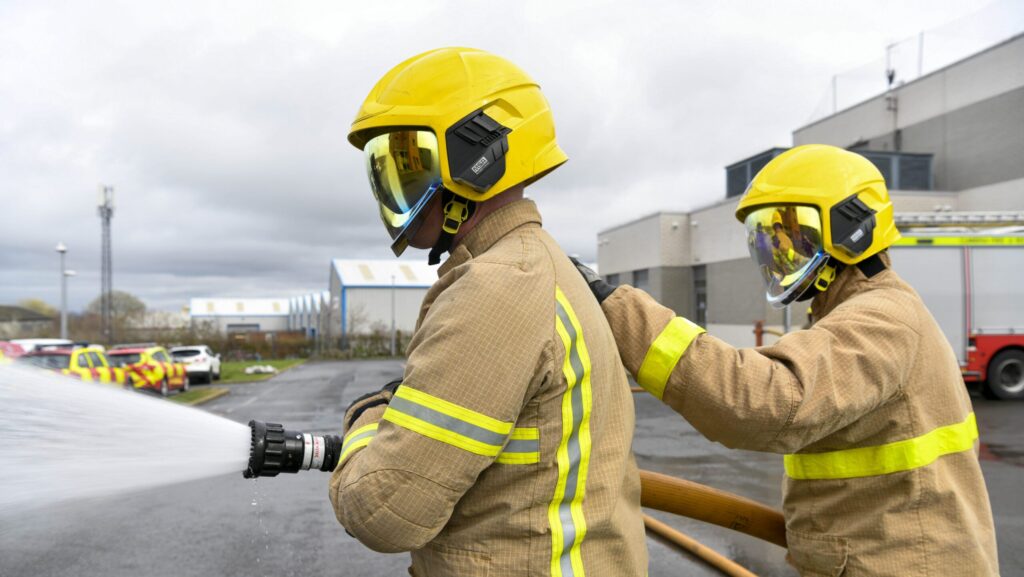
Fire and rescue services are changing emergency response arrangements because of concerns over access to adequate firefighting water, according to the National Fire Chiefs Council (NFCC). NFCC’s new Water Supplies for Firefighting Position Statement warns about the reliability, affordability and resilience of water infrastructure used by firefighters. Fire services change response plans An NFCC survey conducted during summer 2026 found that 81% of responding UK fire and rescue services had changed planned response levels in areas where sufficient firefighting water was difficult to access. More than half had introduced additional measures following significant water supply outages. During the Stourbridge wildfire, West Midlands Fire Service experienced water pressure problems over several days. Crews used a High Volume Pumping Unit to maintain supplies, while replenishing a water carrier took almost 40 minutes at one stage. Hydrant costs increase Fire services have reported inadequate hydrant flow and pressure, delays to infrastructure installation and repairs, inconsistent engagement with water companies and increasing maintenance costs. NFCC said hydrant installation and maintenance charges increased by an average of 85% between 2014 and 2024, with limited transparency reported around how charges are calculated. NFCC calls for national standards NFCC Chair, Phil Garrigan, said: “Firefighters cannot fight fires without water. That sounds obvious, yet our evidence shows four in five fire and rescue services have had to change response plans because of concerns about firefighting water supplies. “We saw the impact of these challenges during the Stourbridge wildfires, where issues with water pressure created additional operational difficulties for crews tackling a major incident. “The demands on fire and rescue services are growing, with larger wildfires, extreme weather and increasingly complex risks. As the task becomes more challenging, the very least firefighters should be able to rely on is access to the water they need to protect people and property.” The organisation is calling for national standards covering firefighting water provision, stronger accountability for water companies and greater transparency around hydrant charges. NFCC also wants fire and rescue services recognised as key stakeholders in future water sector regulation and planning. Its position statement warns that climate change, drought, population growth, housing development, data centres and battery energy storage systems are placing additional demands on water infrastructure. NFCC believes forthcoming water sector reforms provide an opportunity to ensure firefighting requirements are considered in future infrastructure and investment decisions.

NFCC’s warning over firefighting water supplies Read More »

Euralarm publishes firefighting foam disposal guidance. firebuyer.com

Euralarm publishes firefighting foam disposal guidance

Euralarm has published new guidance covering the safe and environmentally responsible disposal of firefighting foam across the UK and Europe. The Guideline on Disposal of Fire Fighting Foam Media provides recommendations for manufacturers, service companies, installers, maintenance providers, end users and waste management specialists. PFAS foam requirements The guidance addresses changing environmental requirements surrounding firefighting foams containing PFAS substances. It covers fluorinated and fluorine free products, including AFFF, FFFP, F3, Class A and Class F foams, alongside wetting agents and water additives. Euralarm outlines relevant European fire protection standards, waste legislation and restrictions affecting PFAS substances. Handling firefighting foam A central recommendation is that all firefighting foam should be considered potentially hazardous unless evidence demonstrates otherwise. Euralarm states that uncontrolled discharge into land, drains or watercourses should be avoided, with waste handled through authorised hazardous waste routes. For foams containing PFAS, the guidance identifies high temperature incineration at licensed facilities as the preferred disposal method and, in many circumstances, a mandatory requirement. Foam servicing and maintenance Recommendations also cover testing and maintenance, including containment of foam, appropriate storage and transport arrangements and recovery of waste from portable extinguishers and fixed suppression systems. Organisations are encouraged to consider transitioning to fluorine free alternatives where appropriate, remove legacy PFAS foam stocks and introduce closed loop recovery systems to reduce the potential for environmental releases. The guidance concludes that firefighting foam should be contained, considered potentially hazardous and disposed of through authorised processes in accordance with applicable standards and environmental legislation.

Euralarm publishes firefighting foam disposal guidance Read More »

Tempest Technology's BB16. firebuyer.com

Battlefield-Ready Reliability

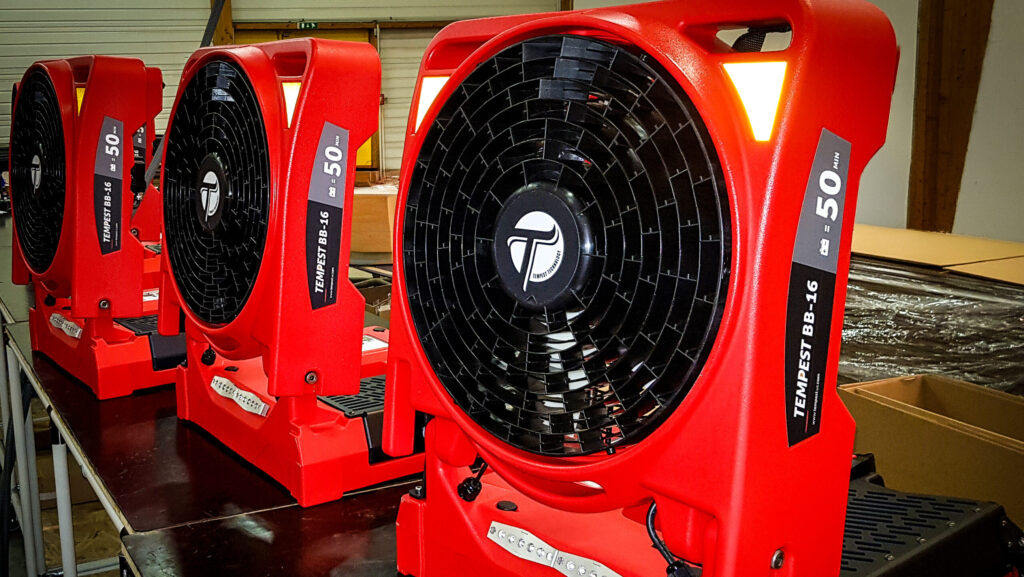
Tempest Technology‘s BB16 combines cordless ventilation, consistent airflow, and flexible positioning for rapid deployment during demanding fireground operations. On the fireground, you do not have time to fight your equipment. Tempest Technology’s BB16 battery-powered fan is built to keep pace with the crew. There is no cord to run, no generator to fire up, and no delay between “we need ventilation” and airflow hitting the structure. How quickly can crews deploy battery powered ventilation? Power is the first thing crews notice. The BB16 delivers 50 minutes of runtime at full power, with no variation in airflow during discharge, meaning constant CFM from the first second to the last. That output translates into 10,940 CFM, enough to clear a structure fast and keep pace with an aggressive attack. Positioning is where the BB16 earns its versatility. An adjustable tilt range of +70° to -90°, locking into 15 distinct positions, lets crews lay the unit flat to cover a utility hole or angle it precisely for a doorway. A fold-out design keeps the fan stable through the intervention, even on uneven ground or under sustained airflow. How does the BB16 reduce battery downtime? Downtime is minimised by design. A three-hour quick charge means the swappable battery pack can be charged while the unit is out working another job, so crews are never left waiting on power. Even with its output, the BB16 stays field-practical: at 53 lbs with battery installed, it is a one-hand, one-shoulder-strap carry, and compact enough to store in a truck cabinet without eating up valuable space. Tempest reports a better weight-to-performance and size-to-performance ratio than its main competitors; a 16 inch model that outperforms its 18 inch and even 20 inch competitors. Visibility underneath the smoke layer is built in, with low-mounted LED lighting helping crews see what they are doing at ground level, where it matters most. How durable is the BB16 for fireground use? Durability matches the demands of the fireground: the BB16 is IP66-rated and drop-tested to 5 feet, built for the job rather than the showroom. The BB16’s usefulness extends well past straight ventilation, with accessories including a high-expansion foam generator, rehab misting system, suction and blowing ducts, and a 12V vehicle charger. No setup. No fuel. No noise complaints from the neighbors. Just cordless power, ready at the moment it is needed. For full specifications or to arrange a demonstration, departments are encouraged to contact Tempest Technology directly.

Battlefield-Ready Reliability Read More »

LEADER launches new firefighting nozzles. firebuyer.com

LEADER launches new firefighting nozzles

LEADER has introduced two aluminium firefighting nozzles, the FLOWMATIC Spinning Teeth and MULTIFLOW Spinning Teeth, designed to combine water delivery with an integrated protective water curtain. The nozzles are available with flow rates of 400 or 500 litres per minute and incorporate spinning teeth technology within the protection jet setting. Protective water curtain The spinning teeth generate a dense water curtain when the nozzle is operated in protection jet mode, providing coverage for firefighters during operations. The technology affects only the protection jet position, leaving the other jet settings unchanged. FLOWMATIC Spinning Teeth provides automatic flow control and is available in 400 and 500 litres per minute versions at 6 bar. MULTIFLOW Spinning Teeth uses a selector ring allowing firefighters to choose between 400 and 500 litres per minute. Flow can then be adjusted using the operating handle. Maintaining jet quality Both nozzles incorporate a stainless steel sliding valve designed to maintain consistent jet quality when partially opened. On the MULTIFLOW model, the valve is also designed to limit water hammer during operation. Six adjustable positions are provided, while a quarter turn allows firefighters to move between a straight jet and a spray pattern of up to 120 degrees. Designed for operational use Construction includes a hard anodised aluminium body, stainless steel valve and polyurethane bumper. Depending on configuration, the nozzles weigh between 1.75 and 1.95kg and include an inlet filter to protect against debris. Both models are available with 1.5 inch BSP F and 2 inch BSP M inlets and carry a five year warranty. Firefighting nozzle standards Both nozzles comply with EN 15182 2. The FLOWMATIC 400 Spinning Teeth has also passed French civil security RT PEREX qualification testing, which assesses extinguishing system performance in user protection, controlling developing fires and rapidly securing smoke layers.

LEADER launches new firefighting nozzles Read More »

MSA G1 City Edition SCBA. firebuyer.com

MSA Safety launches G1 City Edition SCBA

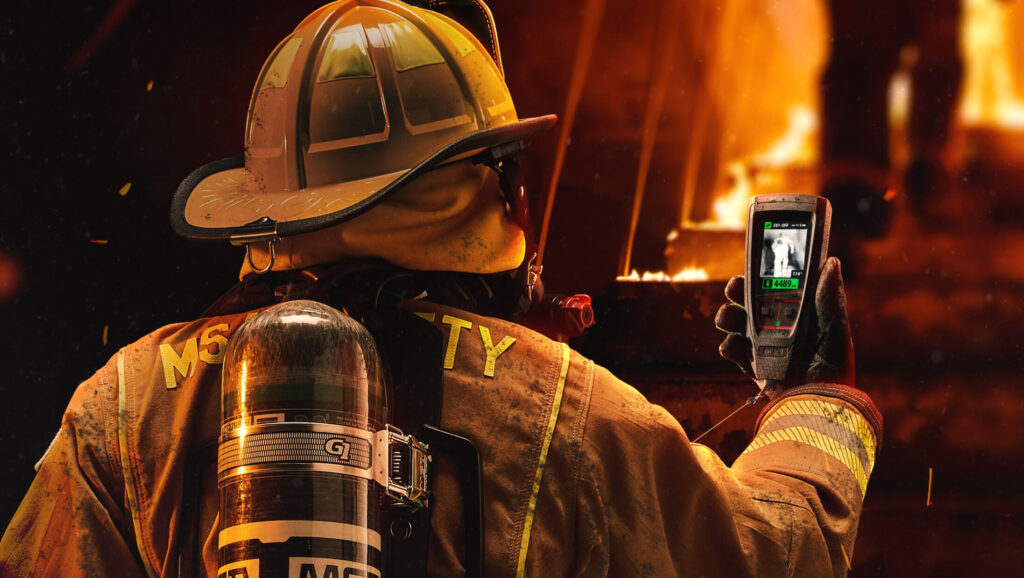
MSA Safety has launched the G1 City Edition SCBA, introducing integrated technology intended to support firefighter search, rescue and accountability. Manufactured at MSA Safety’s Murrysville, Pennsylvania facility, the unit expands the G1 SCBA platform with LUNAR Beacon Technology integrated into its power module. Firefighter search technology The technology allows firefighters carrying a LUNAR Connected Device to search for colleagues wearing a G1 City Edition SCBA. LUNAR combines search and rescue technology, thermal imaging and connectivity. Its FAST network provides directional information towards firefighters in alarm status. When paired with the new SCBA, LUNAR can display air pressure and share alarm status and location information through the FireGrid Monitor application when data or radio connectivity is available. Reduced SCBA weight MSA has also introduced changes intended to reduce weight and improve comfort. A redesigned cylinder retention system provides more than a 10% weight reduction compared with the standard G1 retention band. A low profile swivelling lumbar pad reduces weight by up to half a pound compared with the traditional adjustable configuration and positions the SCBA closer to the firefighter. Firefighter led improvements Updates developed following firefighter feedback include thicker regulator and cylinder valve controls, thinner shoulder pads, longer pull straps, larger strap terminations and facepiece harness changes designed to support one handed donning while wearing gloves. The control module continuously displays cylinder pressure and estimated remaining time. Powered by a single rechargeable battery, the SCBA also incorporates telemetry and connectivity with MSA’s FireGrid ecosystem. Steve Blanco, MSA Safety President and Chief Executive Officer, said: “Firefighters tell us that accountability and the ability to locate personnel quickly during emergency situations are among their highest priorities. “The G1 City Edition SCBA was designed to address those needs while enabling departments to integrate connected technologies into their operations. “As the fire service evolves, we bring new safety solutions to market that meet our customers’ needs while advancing our mission of helping firefighters return home safely after their calls.” The G1 City Edition meets the 2025 edition requirements of NFPA 1970, covering the former NFPA 1981 and NFPA 1982 requirements for structural and proximity firefighting.

MSA Safety launches G1 City Edition SCBA Read More »

Performance Advantage Company SUPERFLEX. firebuyer.com

Securing Essential Equipment Safely

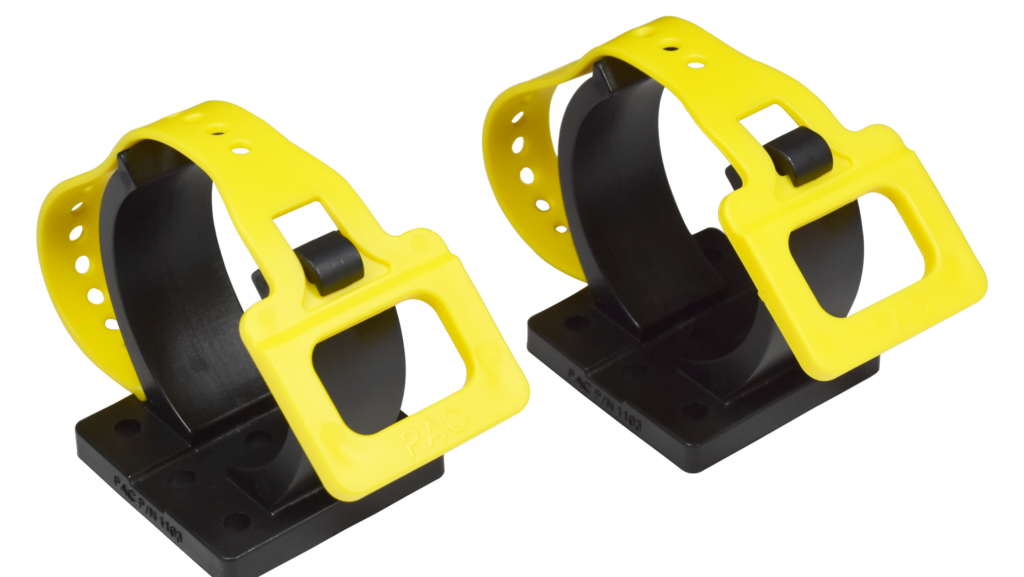
Performance Advantage Company introduces its SUPERFLEX mounting range, designed to secure extinguishers, oxygen bottles and other cylindrical equipment during operations. Performance Advantage Company is proud to feature our SUPERFLEX series of bottle mounts. Our SUPERFLEX kits are available in three designs to provide a secure mount for extinguishers or oxygen bottles or any other cylindrical items. The SUPERFLEX is a self-contained bracket paired with adjustable lock straps to keep your equipment secured and available for quick access. How does SUPERFLEX accommodate different equipment sizes? The smallest (K5043) is capable of securing 3 lb extinguishers from 3 to 3.5 inches in diameter or D-style oxygen bottles. Other cylindrical objects of similar circumference will also fit within this bracket. For larger 5lb extinguishers, or any other cylindrical items measuring 4 to 4.5 inches in diameter use our 4 inch SUPERFLEX (K5044). The 10lb EXTINGUISHER/SCBA MOUNTSUPERFLEX (K5046) is designed to provide a secure mount for large 10lb extinguishers, SCBA or other large bottles. This bracket comes mounted on our MINI DUAL TRAC (7050) backing brace for ultimate security and rigidity. Paired with two clamps and adjustable lock straps, the K5046 is built for ease of use, versatility and rugged construction. How is SUPERFLEX built for operational use? Each SUPERFLEX model is injection molded and thermoformed. Made from high quality materials that are weather and UV resistant. The entire unit is also non-conductive and may be mounted either horizontally or vertically. Each of the SUPERFLEX models are rated for in-cab use, while maintaining the ease of release, even with your gloves on. What configuration options are available? The adjustable locking straps are available with black, orange or yellow straps. What warranty does SUPERFLEX provide? As with all of our PAC products, the SUPERFLEX series all carry a limited lifetime warranty. If any part fails under normal use, we will replace it free of charge upon inspection of the failed part. Performance Advantage Company is proud to provide the best possible customer service. PAC maintains a large inventory to ensure that most orders are fulfilled quickly. Knowledgeable sales, engineering and technical support, installation and training representatives are available to assist customers with their needs. The peace of mind in knowing that the gear you rely on is ready to go when you are is what being PAC Protected is all about. So if you are not already, get PAC Protected.

Securing Essential Equipment Safely Read More »

ROCKWOOL appoints Melanie Marquard as Commercial Director to drive growth in the construction sector and expand operations. firebuyer.com

ROCKWOOL appoints Commercial Director

ROCKWOOL UK and Ireland has appointed Melanie Marquard as Commercial Director as the insulation manufacturer continues to expand its operations and construction sector relationships. Marquard joins ROCKWOOL following more than 25 years working within the construction industry, with experience across the building materials sector. Construction industry experience Before joining ROCKWOOL, Marquard worked at Scandinavian roofing membrane manufacturer Protan, which is also a ROCKWOOL customer. She most recently served as Managing Director for Western Europe at Protan. Her appointment comes as ROCKWOOL continues investment in its UK manufacturing operations, including plans for a new factory in the West Midlands. The company is also continuing investment at its existing stone wool production facility in South Wales. Fire protection specification As Commercial Director, Marquard will lead ROCKWOOL’s specification teams covering fire protection, roofing and external wall applications. She will also work with systems holders, distribution partners and merchants throughout the UK and Ireland. Her responsibilities will include strengthening relationships across the construction supply chain and supporting the company’s response to changing customer and partner requirements. Supporting UK expansion Melanie said: “ROCKWOOL UK & Ireland is well positioned to support its construction industry partners in tackling a range of challenges, from ensuring regulatory compliance to responding to the growing focus on building performance and more sustainable building materials. “Alongside a high-quality product and service offering, ROCKWOOL has an important role to play in helping customers navigate increasingly complex standards and regulations. “Its technical expertise and understanding of the construction industry means it can do more than respond to customers’ needs – it can anticipate the challenges and opportunities shaping their businesses. “Having worked with ROCKWOOL from a customer perspective, I have seen the value of its expertise and the strength of its relationships across the industry. “I’m excited to be joining ROCKWOOL at this pivotal time and look forward to building on those relationships, while identifying new opportunities to support our customers and partners through strong customer service, technical expertise and product innovation.” The appointment forms part of ROCKWOOL’s wider growth plans as it develops its manufacturing capacity and works with customers and partners across the UK and Ireland. Nick Wilson, Managing Director of ROCKWOOL UK & Ireland, said: “Melanie’s extensive industry expertise, combined with the strong network she has built across the construction sector, will be instrumental in helping ROCKWOOL achieve its growth ambitions. “Her experience of the industry, including from a customer perspective, will bring valuable insight to the business. We’re delighted to welcome Melanie to our leadership team.”

ROCKWOOL appoints Commercial Director Read More »

Land Rover Defenders can be transformed into effective wildfire response units through Vallfirest's new Tactical Unit. firebuyer.com

Vallfirest’s Land Rover concept

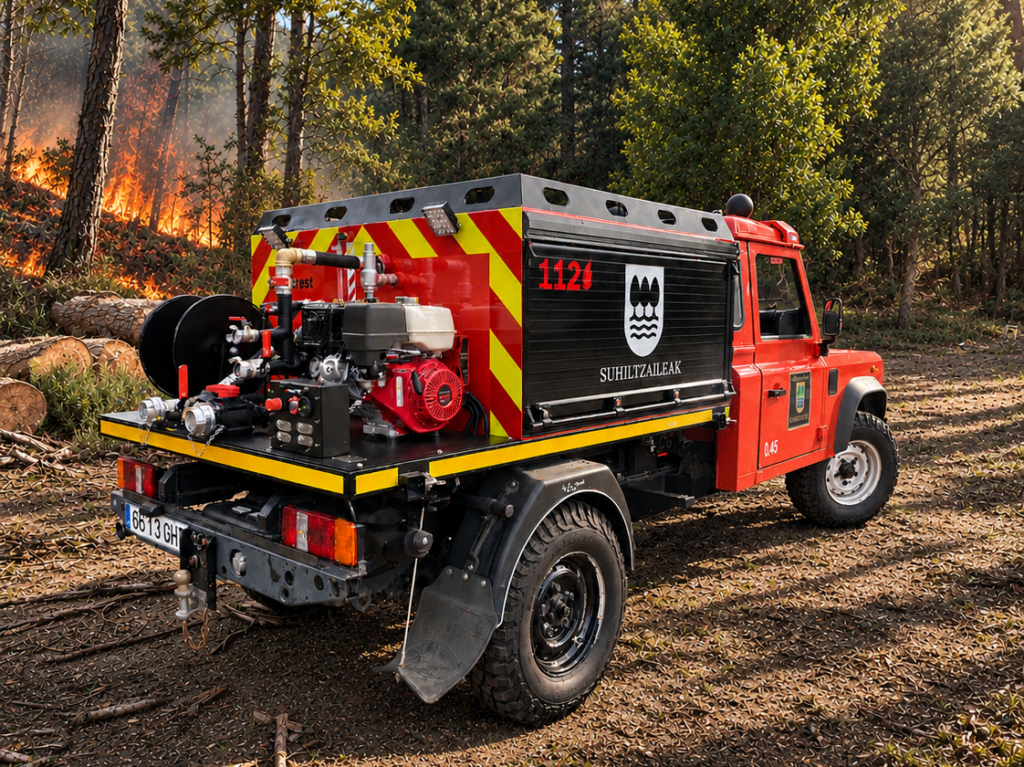
Vallfirest has presented a concept for converting classic Land Rover Defender vehicles into compact wildfire response units using a new version of its Tactical Unit module. Named the Compact Tactical Unit, the proposed system would adapt Vallfirest’s existing modular firefighting equipment to the Defender chassis, creating a light support vehicle capable of operating on narrow forest tracks and difficult terrain. Compact wildfire response Vallfirest’s existing Tactical Unit modules combine firefighting equipment within a removable structure that can be fitted to different vehicle chassis. Current configurations can incorporate water tanks, pumps, hoses, storage for personal protective equipment and hand tools, and an upper cargo area. The company says its mounting system allows a complete module to be removed from a vehicle in under five minutes. For the Defender concept, the equipment would be redesigned into a smaller configuration to accommodate the vehicle’s dimensions and payload capacity. Using existing Defender vehicles Vallfirest sees potential in the global fleet of classic Defender models produced between 1983 and 2016. The company believes restored vehicles could provide a platform for additional wildfire response capacity, supported by the established market for Defender refurbishment. Mechanical diesel variants, including models fitted with 200Tdi and 300Tdi engines, are of particular interest because of their mechanical simplicity and reduced reliance on electronic management systems. Supporting existing fire vehicles The proposed vehicle is intended to complement conventional firefighting appliances rather than replace them. Its compact dimensions and four wheel drive capability could allow crews to transport water, equipment and tools into locations that are difficult for larger vehicles to access. Vallfirest also identifies vehicle refurbishment as a potential way of extending the working life of existing assets rather than manufacturing entirely new platforms. The company said the concept could offer operational, economic and sustainability benefits by combining refurbished vehicles with adaptable wildfire firefighting equipment.

Vallfirest’s Land Rover concept Read More »

Drager Safety UK. firebuyer.com

Capability Beyond the Frontline

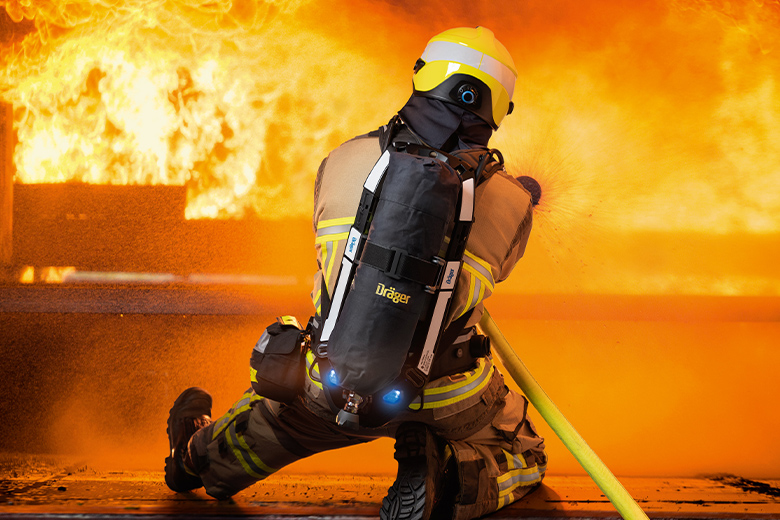
As fire and rescue incidents grow more complex, national resilience depends on robust planning, interoperable communications and reliable access to specialist capability. Gary Walsh, former Chief Fire Officer of East Sussex Fire and Rescue Service and Specialist Advisor on Fire and Rescue Services at Dräger Safety UK, explains how integrating industry partners into the full prevention, preparedness, response and recovery cycle can help ensure services are ready to scale when local resources are stretched. What can large-scale incidents teach us about emergency preparedness? When fire and rescue commanders arrive at a fast-moving, complex incident, lives depend on clear communications, access to the right information and resources, and confidence in working alongside other responders. National resilience creates that confidence in joint working when there is the need to scale up capability quickly. But as incidents become more complex, the demands placed on the current system are increasing and as a result national resilience is under strain. Lessons from major incidents, set out in the Pollock Report (1986), provide clarity that national resilience cannot depend on individual services improvising under dynamic conditions. It requires effective planning, good communications, shared situational awareness, and multi-agency preparedness to deal with incidents that exceed single agency or local capacity. Buncefield is a significant example of the system under strain. On 11 December 2005, explosions at the Hemel Hempstead depot sent up a vast smoke plume and fires burned for several days. Although no lives were lost, more than 40 people were injured, residents and businesses were disrupted, roads were closed, and contaminated firefighting water contributed to long-term groundwater contamination. The incident stretched firefighting, public protection and recovery capability. The Investigation Board’s recommendations on preparedness, communications, command, coordination and recovery remain relevant today because those same factors can determine whether a response to a complex incident is effective. Although Buncefield was exceptional, the pressures it exposed have not gone away. Although Buncefield was exceptional, the pressures it exposed have not gone away. More recently in Essex, a major industrial fire escalated when stored fertiliser exploded. More than 100 firefighters were deployed, nearby residents were evacuated, emergency service vehicles were destroyed and 20 firefighters were treated in hospital. The incident showed again how quickly a fire can stretch crews, equipment, communications and multi-agency coordination. The North Hyde substation fire in March 2025 caused a major power outage forcing Heathrow Airport to close while its internal electrical network was reconfigured. It affected homes, businesses, transport links, hospital services and data centres, showing how one infrastructure failure can have wider consequences across the UK’s critical national infrastructure. At Bicester Motion in May 2025, ten fire crews responded to a major fire at the historic motoring and aviation business park. The incident claimed the lives of two firefighters and a local businessman and left two other firefighters seriously injured before the scene could be moved into recovery. These incidents differ in cause and scale, but they all have similar challenges of protracted operations, stretched local and specialist capability, multiple agencies working under stressful conditions, the demand for data and effective communications. For firefighters, real-time data and communications keep crews safe. When commanders know which of their people are deployed, what they face, where they are and how the incident is developing, they can make better informed decisions. TO READ THE FULL ARTICLE CLICK HERE. 

Capability Beyond the Frontline Read More »

Scroll to Top