Fire fighters in training - Fire Buyer

Emirates Towers: International hospitality goes high-tech

In the hospitality industry, hotel and convention centers are often judged by their technology offerings. As a result, Emirates Towers, a 500-room hotel and business center in Dubai, United Arab Emirates in the Persian Gulf, has set a new standard. A striking addition to the Dubai skyline and among the tallest buildings in the Middle East, Emirates Towers rises 1,165 feet to its top. The office tower alone is host to numerous businesses and its five-star hotel tower offers 500 rooms, including 40 suites and three main theme restaurants. A five-level podium building connects the towers and includes more than 40 retail, restaurant, and parking accommodations.   Scalable technology enables cost-efficient upgrading “The vision for Emirates Towers was to create a state-of-the-art technological infrastructure which could be scalable to future information and building management technology developments,” said Ivan Brinkley, corporate technical director for Jumeirah International, owner of Emirates Towers.   Emirates Towers’ officials understood that retrofitting and  upgrading expenses often represent approximately 50 percent of the lifetime costs of a building and that the ability to upgrade is crucial to ensure that technology remains current. Additionally, scalable technology keeps the cost for installation, operation, and maintenance at a minimum. The goal was to: Implement a state-of-the-art infrastructure which is   • scalable for future developments, Provide the latest available technologies and • integrations to ensure Emirates Tower’s competitiveness, while ensuring a quality building environment, Complete the project with a limited budget • and within a tight time schedule.   With this in mind early in the planning stage, the search began for one company to accept responsibility for the twin-towers system integration and network. Emirates Towers officials approached the local Johnson Controls office to fill this need. Using Johnson Controls’ Technology Contracting approach, property management, guest-related systems, telecommunications, fire, security, and even multimedia applications could be tied together.   Information technology network enables systems cooperation Given the strict criteria for the towers, Johnson Controls introduced a single- seat operation solution through a total integrated IT and building automation system infrastructure with about 20 sub-systems. The logical integration is built around a Metasys system.   Aside from the Metasys system, other major systems include a hotel management system, a facility and property management system, computerised maintenance management systems (CMMS), and telecommunications systems, such as digital video-on-demand (live TV, prerecorded programs, and audio), internet, e-mail services, computer games, and e-commerce. Life safety systems include fire alarm, and closed circuit television (CCTV). Presentation media for conference rooms is available with videoconferencing capabilities, an audio system, and projectors. “As a partner, Johnson Controls was able to provide complete system integration of all the equipment, including elevators, fire alarm systems, and much more, all within the project deadlines. Most importantly, Johnson Controls has the local presence and resources to make ‘doing business’ easy,” said Brinkley.   Physical integration of all the subsystems and applications is achieved through one common IT Network based on ATM (Asynchronous Transfer Mode) and Gigabit Ethernet technology. The network management system handles the high-speed network and its connected devices. The change from a stand-alone system approach to an integrated system leads to significant changes in the engineering and management processes. The key elements to the Emirates Towers Integrated System concept are the Metasys system, ATM-Backbone, and Interactive Guest Multimedia System.   Metasys system is a foundation for integration The basic platform for the integrated solution is the Ethernet technology and TCP/IP (Internet) compatibility of the Metasys family. This provides the foundation for success for the integration technology in Emirates Towers. The use of open protocols and standards in the Metasys system ensured that Emirates Tower’s officials were able to choose the best solutions for creating an intelligent building without losing connectivity or features.   With a 23,000 data point capacity, the Metasys system takes full advantage of the distributed intelligence concept. Four M5 Graphic Workstations create the basis for a personal command center at Emirates Towers to manage the entire BAS network.   Due to the desert climate in Dubai, one of the major issues in the design was maintaining dependable temperature and mechanical control in the building.   Temperatures in the city can reach 120 degrees Fahrenheit between May and October, dropping to the low 80s the rest of the year. If temperature isn’t maintained in the buildings, it could lead to disaffected tenants who don’t renew their leases and dissatised hotel patrons. For this reason, all office areas and guest rooms are provided with advanced LONMARK®-certified DDC controllers connected to the local area network.   One of the main highlights of the system architecture is the various integrations of different voltage systems, including chillers, elevators, and the fire alarm system. A computerised maintenance and management system was integrated for maintenance and facility management. To satisfy the increasing demand for security and property protection, CCTV and an emergency lighting system were integrated. Further integrations to the hotel management system, power monitoring system, and the staff paging system round out the picture of the intelligent building concept. ATM is the backbone of the network At the heart of the network is a modern, scalable ATM backbone designed to easily manage and support services and protocols. ATM technology is the network infrastructure to support high-tech enterprises with various multimedia and voice, video, and data services. It provides the basis for LAN interconnectivity and fully integrated network access. LAN and the ATM backbone are managed by one common network management system. The unique approach includes a redundant IT network solution based on two ATM switches with an individual capacity of 10Gbit per second. The network distributes television, video- on-demand, e-commerce, Internet, BAS, closed circuit television, and hotel management system data through the entire complex.   The integration of the video-on-demand with the hotel management system allows a seamless and online update of the related database for automated billing. The network is modular and flexible, enabling Emirates Towers to start on a smaller scale and expand as needs evolve to support the hotel’s dynamic and changing environment. In addition, the

Emirates Towers: International hospitality goes high-tech Read More »

Modern fire fighting truck in city - Fire Buyer

Think safety, think NAFFCO!

An award winning company Fire fighting equipment manufacturer and fire safety specialist, NAFFCO, is a leader in the industry within the Middle East and, increasingly, in the global marketplace. The company is involved in prestigious projects, and plans for the development of eco-friendly products.   NAFFCO was established in 1991 and has grown to become the largest fire fighting equipment manufacturer in the Middle East and one of the top manufacturers worldwide with manufacturing facilities in Dubai serving clients in 100 different countries across the globe.   The motivation behind setting up NAFFCO was sheer goodwill towards society by providing fire protection engineering products. This field was not very well developed or established in the Middle East market at the time, so the in-depth knowledge and expertise gained by Eng. Khalid El Khatib in the field motivated him to start a small manufacturing unit in 1991. The company started with only 11 employees and has now grown to employ more than 5,000 employees. This was only possible due to his vision to become a global leader in providing comprehensive and reliable fire protection solutions and safety engineering and making the world a safer place to live. World-class products The company’s core business focuses on the manufacture, design, supply, installation and after sales service of fire fighting products, ranging from basic fire extinguishers to highly sophisticated fire trucks. The company is staffed by highly-trained and experienced technicians and engineers and provides total fire protection solutions to the most prestigious developments around the world, including residential buildings, commercial complexes, telecommunication centers, industrial installations, oil refineries, petrochemical plants and airport installations.   The headquarters and manufacturing facilities are located in the United Arab Emirates, where a wide range of innovative fire fighting equipment is manufactured with the company’s state-of-the-art technology, having established a sales presence in over 100 countries in Africa, Europe, the Middle East, Russia, America, GCC and Asia. The company is renowned for providing superb quality products and assuring the timely performance of its products at all times. With simple yet effective fire extinguishers of all sizes, custom-made fire cabinets, heavy duty fire hoses, high capacity powerful pumps, mobile fire fighting systems, including CAFS (compressed air foam systems), and highly advanced fire trucks, NAFFCO is dedicated to the science of fire fighting.   Moreover, NAFFCO has diversified from the passive fire protection arena and is now one of the specialists in the field of automation and control for all types of fire alarm and security systems. NAFFCO even opened new divisions like Fire Doors and Flow control divisions to manufacture HDPE pipes and fittings for under ground waterlines to meet growing demand of customers. With its consistent focus on commitment to quality and a desire to develop world-class engineering products, NAFFCO is one of the world’s top five manufacturers of total fire protection and safety engineering solutions. Landmark projects NAFFCO’s excellent reputation has enabled the company to be involved in a large number of landmark projects in a wide range of industries. The markets the company deals with includes residential buildings, commercial complexes, telecommunication centers, industrial installations, oil refineries and petrochemical plants, airport installations, power plants and substations, and the metal processing industry.   Two of the most important projects the company has been involved in are the Burj Khalifa in Dubai – the tallest tower in the world – and the Masdar Institute of Science and Technology in Masdar City, Abu Dhabi. For the Burj Khalifa, NAFFCO provided and installed the fire fighting system consisting of fire hose reels, wet risers and landing valves; the sprinkler system consisting of different types of sprinklers like upright and sidewall sprinklers, which are recessed sprinklers connected by zone control and alarm check valves; and the gas suppression system consisting of HFC-227ea gas with fire extinguishing panel, abort switch, manual release, manual actuator, fire alarm bell and flashers.   This equipment was installed under NAFFCO supervision and is monitored by the main fire alarm panel. It also installed the pre- action system consisting of a control panel, pre-action valve, air compressors and sprinklers; the foam deluge system consisting of foam control panel, deluge valve, foam tank and nozzles; and the external hydrant consisting of a valve, which is installed outside the building premises and is connected to the fire pump. All the design, supply, supervision of installation, testing and commissioning and final hand-over was done by NAFFCO as per NFPA (National Fire Protection Association) standards and local authority approvals.   For the Masdar Institute of Science and Technology, a project valued at approximately AED 18 million (US$4.9 million), NAFFCO undertook the design, supply, installation, site supervision, testing and commissioning of all the fire fighting systems, fire alarm systems, and voice evacuation systems. The company has also provided its services to the Dubai Metro, the New Abu Dhabi International Airport 2K, Emirates Aluminum Company and Dubai Festival City.    Committed to quality The reason NAFFCO has such a good reputation is explained by a number of attributes. The first of which is its commitment to quality. “NAFFCO’s ISO 9001 quality management system is certified by UL (Underwiters Laboratories), LPCB (Loss Prevention Certification Board) and BV (Bureau Veritas). The company always endeavors to continually and effectively improve the quality of products in accordance with the requirements of international standards like LPCB, BSI (British Standards Institution), SAI Global, UL, FM Global and NFPA.   In recognition of the success of its business growth, NAFFCO was awarded the prestigious Mohammed Bin Rashid Al Maktoum Business Award in 2005 for excellence in exports and 2006 in manufacturing. The Dubai Quality Appreciation Award in 2008 bears further witness to its constant focus towards the excellence of its business and the quality of services it provides.   And recently NAFFCO added one more testament of its excellence when it was awarded again the prestigious Mohammed Bin Rashid Al Maktoum Business Award in 2010 for manufacturing under the free zone category. The key strengths of NAFFCO are the highly qualified engineers who carry out and ensure the provision of the highest quality products.   And through its Research and Development department, NAFFCO was able to maintain the continuous production of new technology systems to meet future demands, and to expand our product lines. Furthermore, NAFFCO is an associated member of the NFPA,

Think safety, think NAFFCO! Read More »

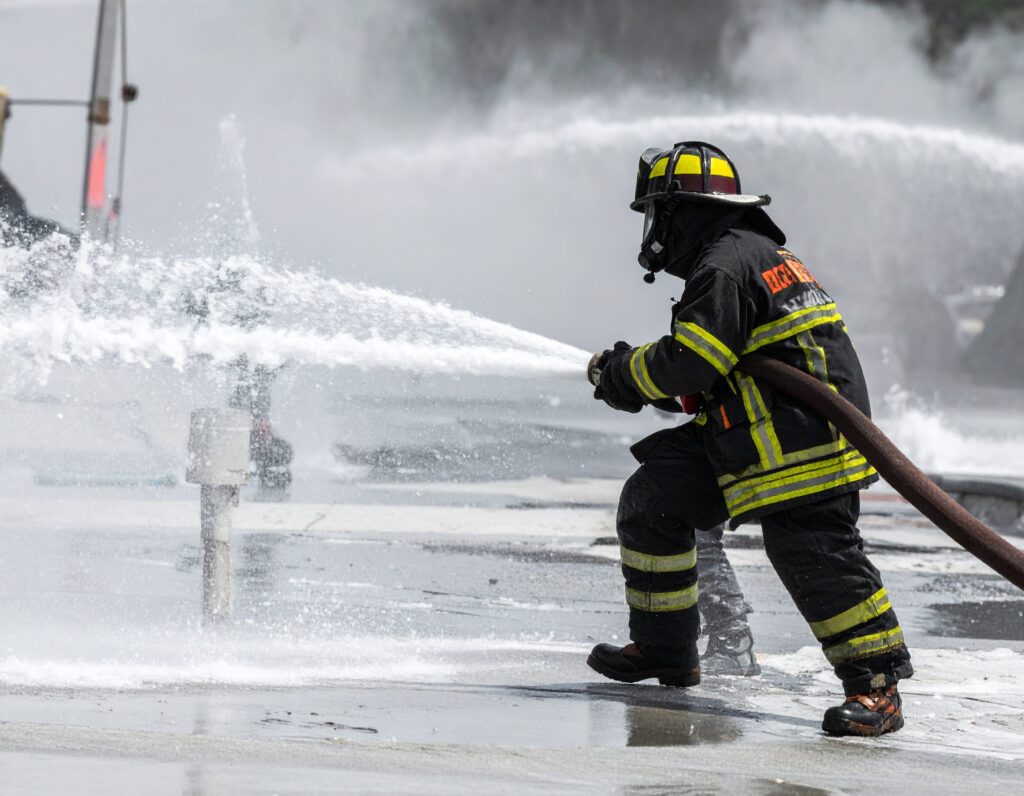
Firefighting foam being sprayed from fire hose - Fire Buyer

SICUR 2012

Teaser: Madrid Exhibition Centre, Madrid, Spain SICUR brings together the entire safety and security industry, making up a comprehensive showcase of new developments relating to protection and prevention in the widest sense of these terms. Website: www.infoifema.es

SICUR 2012 Read More »

Firefighting foam being sprayed from fire hose image - Fire Buyer

Intersec Dubai UAE

Teaser: Trade fair and conference Over the years Intersec trade fair and conference has garnered much support from government entities, particularly UAE Civil Defence, all departments of Dubai Police, Dubai Police Academy and the event continues to attract the key players from across its different sectors.   Website: www.intersecexpo.com

Intersec Dubai UAE Read More »

Image of Wildfire - Fire Buyer

Packexe Case Study

Packexe SMASH has become the tool for fire-fighters during extrication situations, ensuring the dangers of broken glass are reduced for casualties and rescuers alike. The year 2011 has seen the number of countries worldwide where Packexe SMASH is in service rise to 29 and the number of UK fire brigades using it climb to over 20. Early in the year, Northern Ireland Fire and Rescue Service adopted Packexe SMASH equipping each front-line appliance with the system. Hampshire Fire and Rescue is another brigade to have it on all front-line appliances. Mark Woods, Watch Manager Training Centre/OIC Botley, Hampshire Fire and Rescue Service (HFRS) said: “Since the first evaluation of Packexe SMASH within the HFRS Extrication Team and Service Training Centre it has changed the way in which we manage glass. Packexe SMASH allows a dynamic approach to the way in which glass is managed, increasing safety and reducing extrication times as part of the vehicle preparation stage at an RTC. Since we adopted it as part of the Officer in Charge’s dynamic risk assessment, Packexe SMASH has undoubtedly improved the health and safety of casualties and rescuers alike. The product is innovative and easy to use and has also proved itself versatile for use when forced entry is required into buildings through areas of glass, giving a safe and efficient control measure.” Malcolm Freemantle, Equipment and Procurement Officer for HFRS continues: “The time factors relating to vehicle preparation at RTCs prior to cutting operations can now be significantly reduced due to the new protocols adopted by Hampshire with the introduction of Packexe SMASH. Time is a crucial factor in tackling RTCs. The product allows our staff far more flexibility in the dynamic risk assessment of glass at RTCs, allowing us to take into account vehicle orientation and casualty position.” In 2011, Packexe SMASH was seen and used in all the major extrication challenges, including the 2011 International Auto Extrication Challenge in the USA, the World and Australasian Rescue Challenges and the UK National Challenge. A significant highlight from these Challenges was the feedback from the casualties. This was exemplified by Jayne Hazlett, an acting casualty from the World and Australasian Rescue Challenges 2011 who said, “Until you are in a car and windows are broken around you, then you have no idea how much actually does fly about.” During the World and Australasian Rescue Challenges, the difference in results when Packexe SMASH was used and not used were significant and apparent to all who took part. Steff Dewhurst, Bhsc Paramedic Student, Wellington, New Zealand, who acted as a casualty, states: “As a paramedic student I believe it is vital that I gain an understanding of how it feels to be a patient. Being in a simulated car crash was very surreal for me, as I was able to place myself exactly into the shoes of a patient being extricated from a major accident. In the first incident I was a part of I played an ‘unconscious’ patient and was not able to move or communicate with my rescuers. During the rescue, as glass was being smashed there was a loud bang and all of a sudden glass was raining down all over me. The glass went into my ears, fell under my safety glasses on to my face and was all through my hair. I got such a fright; I jumped and was nervous for the rest of the rescue, even though I had complete faith in my rescuers.” When the Fire and Rescue Service need to extricate a casualty, it is important to make the casualty feel calm and to sense that the situation is under control. An essential feature of Packexe SMASH’s self-adhesive film is its transparency, which is vital to maintain visibility at all times for the benefit of the casualty and rescuer. This will, in some cases, help to keep the casualty calm, as they will be able to clearly see what the rescue team are achieving. Steff continues, saying “In the next incident I was a part of, the crew chose to use Packexe SMASH. The difference in the rescue was phenomenal. Not only was the noise of the glass breaking greatly reduced, but there were no shards of glass falling on me and I felt a lot more safe and secure. I didn’t need to worry about glass shards or sharp edges. It was great; the environment for both the rescuers and me was a lot more secure.” To conduct an effective and successful extrication, certain equipment is required. The amount and variety of tools available is significant. However, the key focus is to create the safest and quickest route possible to remove the accident victim from the vehicle. One aspect of the extrication process is to break the glass whilst attempting to reduce the risk of injury from glass fragments for the victims, fire fighters and other emergency services. Packexe SMASH, a unique self-adhesive film and applicator, saves time, as the application can be completed by one person, allowing other fire-fighters to take care of the casualty. In comparison, the traditional methods that consist of hard and soft protection (body shields and blankets) have always proved to be a two- or three-person job. By reinforcing the glass, Packexe SMASH has eliminated the need to forcibly break and remove it. The application of Packexe SMASH increases the strength of glass by approximately 42%, greatly reducing the risk of breakage. This allows fire-fighters to leave it in place whilst hydraulic cutting and spreading equipment is in use. If glass has to be broken and removed, with Packexe SMASH applied first, it can be folded and disposed of with ease, allowing a safer and easier clean-up. Jayne Hazlett continues by saying: “I did find that the crews who used Packexe SMASH in the pits saved a lot of the extra glass from hitting us as patients… I got to experience it [Packexe SMASH] first hand in the vehicles and was impressed with the speed [of

Packexe Case Study Read More »

Firefighting foam being sprayed from fire hose image - Fire Buyer

Emirates Towers

In the hospitality industry, hotel and convention centers are often judged by their technology offerings. As a result, Emirates Towers, a 500-room hotel and business center in Dubai, United Arab Emirates in the Persian Gulf, has set a new standard. A striking addition to the Dubai skyline and among the tallest buildings in the Middle East, Emirates Towers rises 1,165 feet to its top. The office tower alone is host to numerous businesses and its five-star hotel tower offers 500 rooms, including 40 suites and three main theme restaurants. A five-level podium building connects the towers and includes more than 40 retail, restaurant, and parking accommodations. Scalable technology enables cost-efficient upgrading “The vision for Emirates Towers was to create a state-of-the-art technological infrastructure which could be scalable to future information and building management technology developments,” said Ivan Brinkley, corporate technical director for Jumeirah International, owner of Emirates Towers. Emirates Towers’ officials understood that retrofitting and upgrading expenses often represent approximately 50 percent of the lifetime costs of a building and that the ability to upgrade is crucial to ensure that technology remains current. Additionally, scalable technology keeps the cost for installation, operation, and maintenance at a minimum. The goal was to: Implement a state-of-the-art infrastructure which is scalable for future developments, Provide the latest available technologies and integrations to ensure Emirates Tower’s competitiveness, while ensuring a quality building environment, Complete the project with a limited budget and within a tight time schedule. With this in mind early in the planning stage, the search began for one company to accept responsibility for the twin-towers system integration and network. Emirates Towers officials approached the local Johnson Controls office to fill this need. Using Johnson Controls’ Technology Contracting approach, property management, guest-related systems, telecommunications, fire, security, and even multimedia applications could be tied together. Information technology network enables systems cooperation Given the strict criteria for the towers, Johnson Controls introduced a single- seat operation solution through a total integrated IT and building automation system infrastructure with about 20 sub-systems. The logical integration is built around a Metasys system. Aside from the Metasys system, other major systems include a hotel management system, a facility and property management system, computerised maintenance management systems (CMMS), and telecommunications systems, such as digital video-on-demand (live TV, prerecorded programs, and audio), internet, e-mail services, computer games, and e-commerce. Life safety systems include fire alarm, and closed circuit television (CCTV). Presentation media for conference rooms is available with videoconferencing capabilities, an audio system, and projectors. “As a partner, Johnson Controls was able to provide complete system integration of all the equipment, including elevators, fire alarm systems, and much more, all within the project deadlines. Most importantly, Johnson Controls has the local presence and resources to make ‘doing business’ easy,” said Brinkley. Physical integration of all the subsystems and applications is achieved through one common IT Network based on ATM (Asynchronous Transfer Mode) and Gigabit Ethernet technology. The network management system handles the high-speed network and its connected devices. The change from a stand-alone system approach to an integrated system leads to significant changes in the engineering and management processes. The key elements to the Emirates Towers Integrated System concept are the Metasys system, ATM-Backbone, and Interactive Guest Multimedia System. Metasys system is a foundation for integration The basic platform for the integrated solution is the Ethernet technology and TCP/IP (Internet) compatibility of the Metasys family. This provides the foundation for success for the integration technology in Emirates Towers. The use of open protocols and standards in the Metasys system ensured that Emirates Tower’s officials were able to choose the best solutions for creating an intelligent building without losing connectivity or features. With a 23,000 data point capacity, the Metasys system takes full advantage of the distributed intelligence concept. Four M5 Graphic Workstations create the basis for a personal command center at Emirates Towers to manage the entire BAS network. Due to the desert climate in Dubai, one of the major issues in the design was maintaining dependable temperature and mechanical control in the building. Temperatures in the city can reach 120 degrees Fahrenheit between May and October, dropping to the low 80s the rest of the year. If temperature isn’t maintained in the buildings, it could lead to disaffected tenants who don’t renew their leases and dissatised hotel patrons. For this reason, all office areas and guest rooms are provided with advanced LONMARK®-certified DDC controllers connected to the local area network. One of the main highlights of the system architecture is the various integrations of different voltage systems, including chillers, elevators, and the fire alarm system. A computerised maintenance and management system was integrated for maintenance and facility management. To satisfy the increasing demand for security and property protection, CCTV and an emergency lighting system were integrated. Further integrations to the hotel management system, power monitoring system, and the staff paging system round out the picture of the intelligent building concept. ATM is the backbone of the network At the heart of the network is a modern, scalable ATM backbone designed to easily manage and support services and protocols. ATM technology is the network infrastructure to support high-tech enterprises with various multimedia and voice, video, and data services. It provides the basis for LAN interconnectivity and fully integrated network access. LAN and the ATM backbone are managed by one common network management system. The unique approach includes a redundant IT network solution based on two ATM switches with an individual capacity of 10Gbit per second. The network distributes television, video- on-demand, e-commerce, Internet, BAS, closed circuit television, and hotel management system data through the entire complex. The integration of the video-on-demand with the hotel management system allows a seamless and online update of the related database for automated billing. The network is modular and flexible, enabling Emirates Towers to start on a smaller scale and expand as needs evolve to support the hotel’s dynamic and changing environment. In addition, the system design ensures that any future upgrade to the

Emirates Towers Read More »

Modern British Fire alarm on wall - Fire Buyer

High-rise building fires

In 2005-2009, there were an average of 15,700 reported structure fires in high-rise buildings per year and associated losses of 53 civilian deaths, 546 civilian injuries, and $235 million in direct property damage per year. Four property classes account for roughly half of high-rise fires: office buildings, hotels, apartment buildings, and facilities that care for the sick. Automatic fire protection equipment and fire-resistive construction are more common in high-rise buildings that have fires than in other buildings of the same property use that have fires. The risks of fire, fire death, and direct property damage due to fire tend to be lower in high-rise buildings than in shorter buildings of the same property use. In 2005-2009, an estimated 15,700 reported high-rise structure fires per year resulted in associated losses of 53 civilian deaths, 546 civilian injuries, and $235 million in direct property damage per year. An estimated 2.6% of all 2005-2009 reported structure fires were in high-rise buildings. The trends in high-rise fires and associated losses (inflation-adjusted for property damage) are clearly down, but the sharp post-1998 reduction appears to be mostly due to the change to NFIRS Version 5.0, which is shifting estimates to lower levels that also appear to be more accurate. Four property classes account for roughly half of high-rise fires: apartments, hotels, facilities that care for the sick, and offices. In 2005-2009, in these four property classes combined, there were 7,800 reported high-rise structure fires per year and associated losses of 30 civilian deaths, 352 civilian injuries, and $99 million in direct property damage per year. The property damage average is inflated by the influence of one 2008 hotel fire, whose $100 million loss projected to nearly $40 million a year in the analysis. This report emphasises these four property classes. Some other property uses – such as stores and restaurants – may represent only a single floor in a tall building primarily devoted to other uses. Some property uses – such as grain elevators and factories – can be as tall as a high-rise building but without a large number of separate floors or stories. For these reasons, the four property use groups listed above define most of the buildings we think of as high-rise buildings, and their fires come closest to defining what we think of as the high-rise building fire problem. By most measures of loss, the risks of fire and of associated fire loss are lower in high-rise buildings than in other buildings of the same property loss. This statement applies to risk of fire, civilian fire deaths, civilian fire injuries, and direct property damage due to fire, relative to housing units, for apartments, and risk of fire for hotels, offices, and facilities that care for the sick. The usage of wet pipe sprinklers and fire detection equipment is higher in high-rise buildings than in other buildings, for each property use group. Even so, considering the extensive requirements in NFPA 101®, Life Safety Code, for fire and life safety features in both new and existing high-rise buildings, it seems clear that there are still major gaps, particularly in adoption and enforcement of the provisions requiring retrofit of automatic sprinkler systems and other life safety systems in existing high-rise buildings. NFPA 1®, Fire Code, has sprinkler retrofit requirements. This has implications for public officials and ordinary citizens in any city. Public officials should make sure that the latest editions of NFPA 1®, Fire Code, and NFPA 101®, Life Safety Code, are in place and that the codes they have are supported by effective code enforcement provisions, including plan review and inspection processes, both for new construction and for continued supervision of code compliance in existing buildings. The public can take responsibility for their own safety by insisting that their public officials take these steps. As in so many areas of fire safety, we know what to do, but we still need to do it. The trend had been toward a smaller share of fires being reported each year as occurring in buildings with fire-resistive construction, both for high-rise and other buildings, with the decline being most dramatic in facilities that care for the sick. This statistical decline could reflect any or all of the following: (a) a shift in construction between the two types permitted by codes, from Type I (442 or 332) construction, which is coded as fire-resistive, to Type II (222) construction, which is coded as protected non-combustible; (b) a shift to acceptable alternative designs using more sprinklers and less fire-resistive construction; or (c) enough success in containing fires that a rising fraction never are reported to fire departments, because the fires are caught and controlled so early by occupants. Most high-rise building fires begin on floors no higher than the 6th story. The fraction of 2005- 2009 high-rise fires that began on the 7th floor or higher was 32% for apartments, 22% for hotels and motels, 21% for facilities that care for the sick, and 39% for office buildings. The risk of a fire start is greater on the lower floors for apartments, hotels and motels, and facilities that care for the sick, but greater on the upper floors for office buildings. High-rise apartments have a slightly larger share of their fires originating in means of egress than do their shorter counterparts (4% vs. 3%). The same is true of hotels (7% vs. 5%) and facilities that care for the sick (6% vs. 4%). In offices (4% vs. 6%), the differences in percentages are in the opposite direction, which means that high-rise buildings in those properties have a smaller share of their fires originating in means of egress. In all four property classes, the differences are so small that one can say there is no evidence that high-rise buildings have a bigger problem with fires starting in means of egress. U.S. high-rise building fires fact sheet In 2005-2009, U.S. fire departments responded to an average of 15,700 structure fires in high-rise buildings. These fires caused an annual average of:

High-rise building fires Read More »

Modern fire fighting truck in city - Fire Buyer

Managing future emergencies

The new generation of mobile emergency command vehicles is helping deliver huge improvements in the way emergency services manage the different types of incidents they have to deal with. In the past commanders and their support teams may have used old style incident command vehicles, usually little more than mobile (paper) map rooms with a few radios and whiteboards. Not any more. Now services are in an era of improved communications across incident grounds and back to headquarters, using mobile satellite broadband, live wireless video and other solutions, thereby delivering high speed data flows and real time situational awareness and a Common Operational Picture – within all levels of services and between services. This is important, because it means services are now able to perform much more effectively (and some of the mistakes of the past, highlighted by major incidents where lives have been lost unnecessarily, are less likely to happen). Supporting this pioneering collaborative work within emergency services around the world, UK-based Excelerate Technology Ltd has helped drive the development of what are considered to be some of the world’s most advanced mobile emergency management vehicles. This is generating growing international interest, including from the Middle East. Emergency services and civil defence forces and agencies are interested in learning about highly innovative UK projects such as the HART (Hazardous Area Response Teams) programme, which is delivering a standardised, national approach for UK ambulance services dealing with incidents inside the ‘hot zone’, such as CBRN attacks, USAR incidents, chemical spills and releases, as well as other threats to life. Excelerate Technology has supported these initiatives by sourcing, developing and introducing many of the new technologies that emergency services have needed to implement their plans. Key among these technologies has been the use of mobile satellite broadband and wireless solutions to deliver data, voice, internet and video to commanders. Ten years ago the company was quick to see the potential of these emerging technologies and to adapt them for specific emergency service use, working closely with customers, such as the national HART ambulance service project team, the fire services and police forces. Critical to the success of these developments has been the need to identify how emergency service communications requirements can be best supported by the use of new technologies, followed by prototyping, systems integration within compact and ergonomically suitable work spaces, displays and control panels, thereby creating easy-to-use solutions. This has been complemented with testing, training and exercising to deliver maximum operational benefits for the investments made. These solutions are now being seen in increasing numbers of forward command vehicles and incident command units around the UK and the world, vehicles which are changing command doctrine and the way emergency services work. While there are variations in the different types of command suites and technologies used within the various emergency command vehicles supported by Excelerate Technology, there is generally a core set of common systems, features and functionality. Some of these solutions are unique to Excelerate, having been developed by the company’s Research and Development department. To help services identify which solutions are likely to be of most use to them, Excelerate has compiled a short User’s Guide to Mobile Emergency Command Solutions, Mobile satellite broadband communications This is at the heart of Excelerate’s technology offering, providing commanders with a robust, easily accessible and high capacity capability. Roof-mounted transportable satellite solutions provide resilient stand-alone broadband connections giving access to secure telephony, data, video, internet and email facilities. Satellite broadband is highly robust, a key factor during major emergencies when other communications systems can be overloaded. Satellite communications enable command and control vehicles to receive and transmit data from all responders and emergency teams and achieve a Common Operational Picture. Combined with wireless networks, personnel using PDAs, laptops, mobile phones and data terminals can access tactical plans, live video streaming or information from strategic emergency planning software. The range can be extended using self-powered, rapidly deployable MESH wireless nodes. For maximum resilience, vehicles can communicate directly with each other as well as their appropriate HQs and other locations. Some HQs, such as the West Yorkshire FRS, are now also using satellite broadband receivers at their command centre as well as on their mobile command vehicle. Wired, wireless and rapidly deployable cameras for live video viewing Optical and dual-thermal cameras can be mounted on self-powered tripods, the Sherpa climbing camera platform, extendable, pneumatic masts and aerial platforms to transmit live video by COFDM into ICUs and control rooms for viewing by command staff operating at the scene of an incident, and streamed via secure servers to higher level command for online access in real-time by authorised personnel. Body-worn cameras, such as those worn by Gwent Police mobile officers on bikes during the Ryder Cup, can also be used to provide fast reaction video of incidents. In addition, Excelerate can install receivers to provide ‘heli-tele’ downlinks, allowing aerial images from police helicopters and UAVs to be viewed in the command vehicle. Digital Dashboard Management Interface (DDMI) The Digital Dashboard Management Interface (UK Patent Application 1116053.8) is a highly innovative new solution which enhances system performance, reliability and communications interoperability. The Digital Dashboard Management Interface gives users vital data at a glance. This new digital dashboard display system has been designed by Excelerate Technology’s R&D department specifically for the emergency services market to provide a clear, intuitive interface linked to the wide variety of command and support technologies found on the latest generation of incident command vehicles. The company has already received the Department of Health’s authorisation to begin implementing DDMI into all HART Command vehicles. The simple-to-use interface enables operators to monitor and control the systems and technologies on board command and control units effectively and efficiently, enabling them to focus primarily on their operational roles and to get the best out of their technology and training investment. Modules within the DDMI include the Communications Management Suite (PBX). This module has been developed to enable multiple communications devices including radios, GSM, TETRA, mobile and VoIP

Managing future emergencies Read More »

Scroll to Top