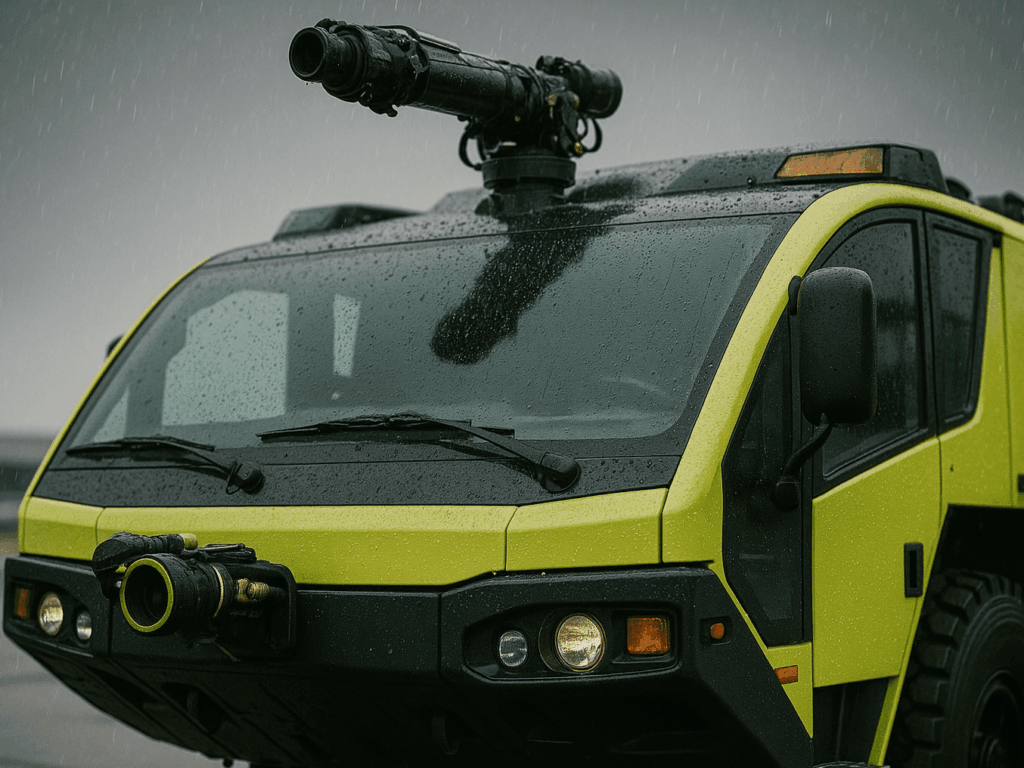
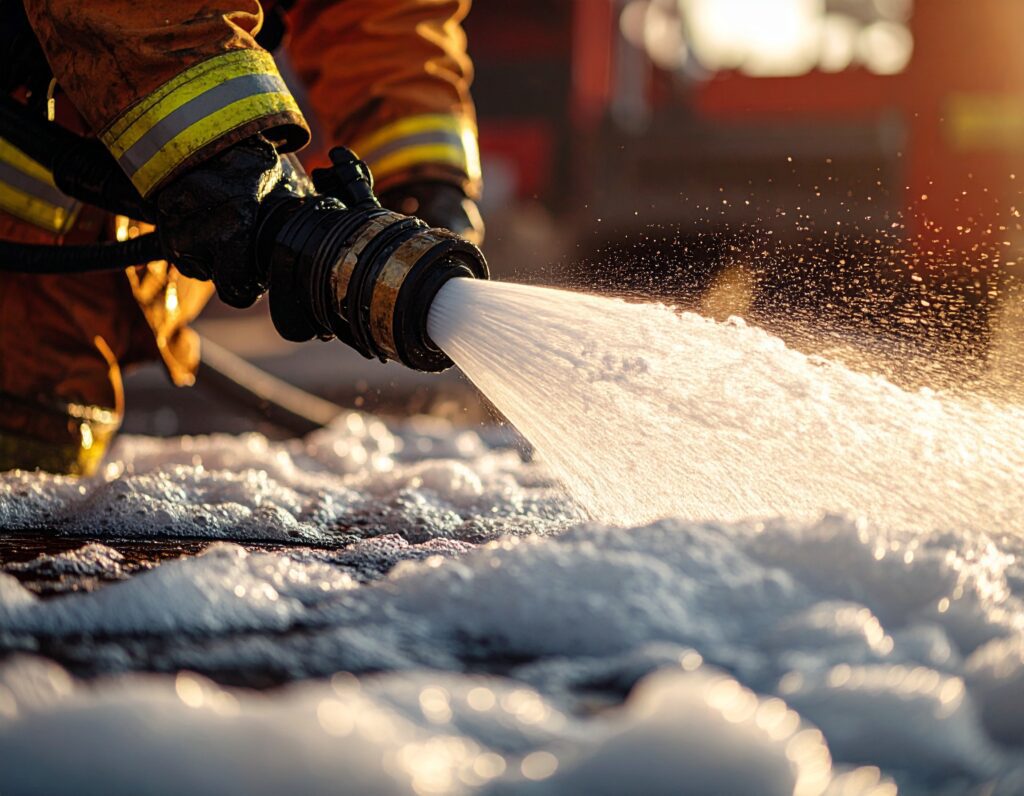
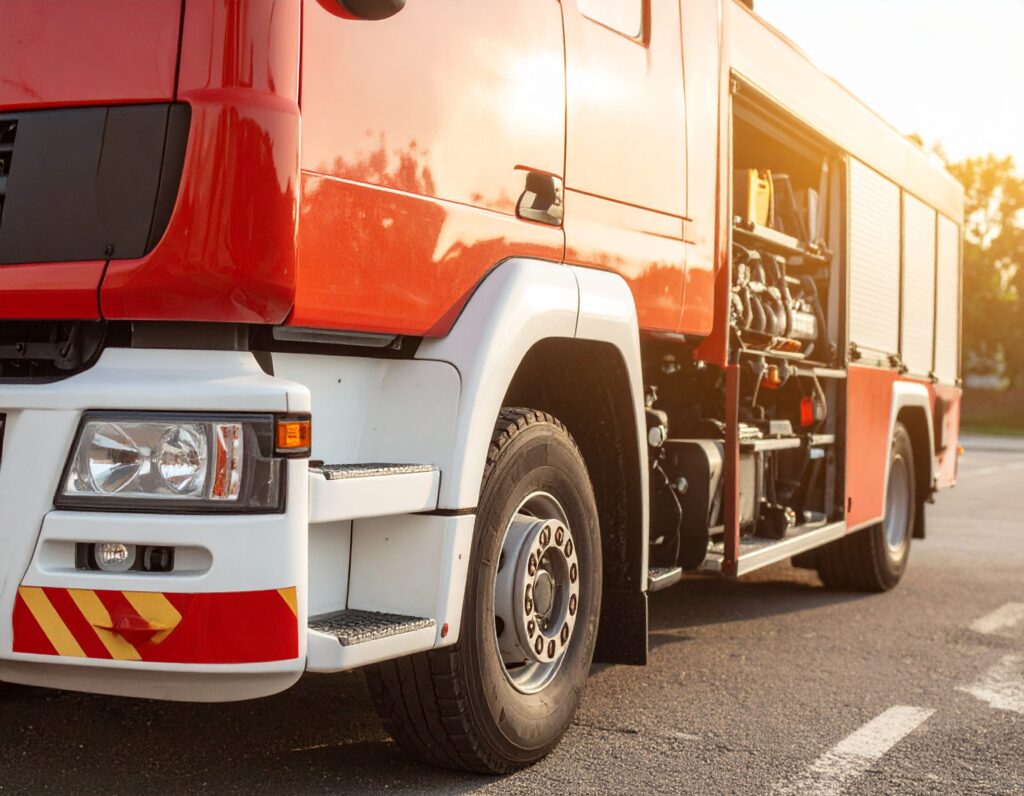
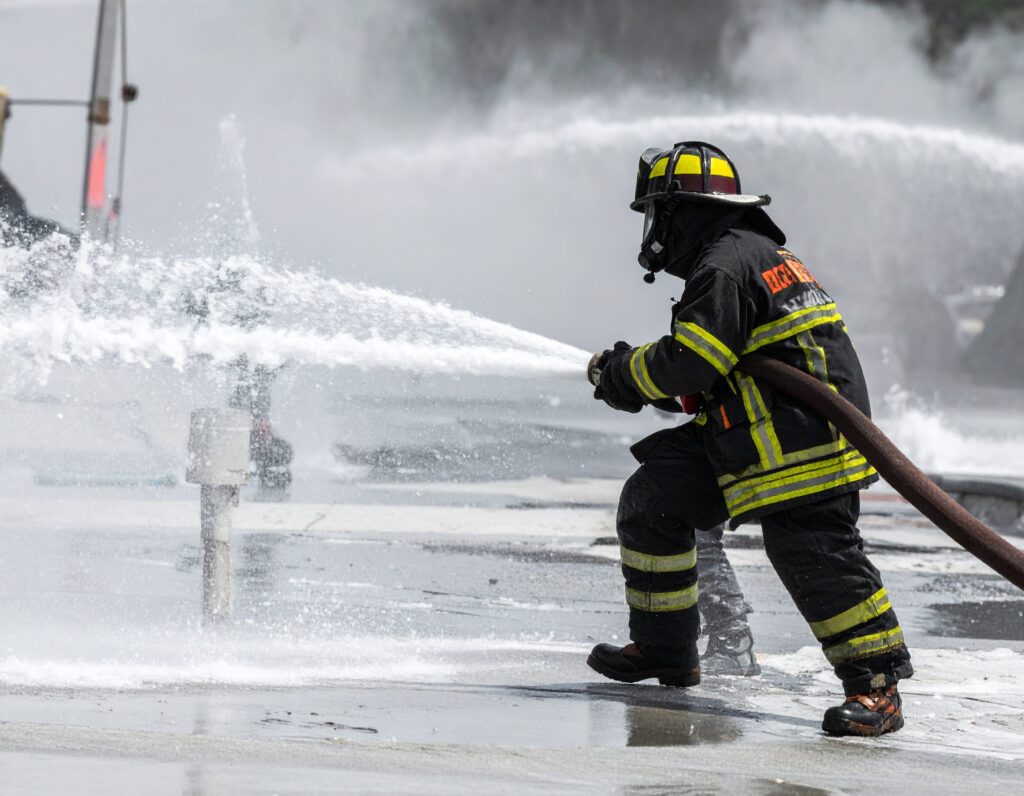
Jubilee in the premium class Kate Prendergast, Editor took a trip to Linz, Austria to see the unveiling of the 1,000th Panther ARFF with its outstanding drive and extinguishing performance I was lucky enough to be invited to Linz to attend the unveiling ceremony of the 1000th Panther ARFF vehicle. To mark the production of the 1,000th Panther, on May 14th 2012, three trucks were ceremonially handed over to the Stansted-London (1000th), Düsseldorf (999th) and New Doha (production number “1001”) international airports. The vehicles in question consist of a Panther 6×6, a Panther 8×8 with short wheelbase and a Panther 8×8. They are thus representative of the range of variations in which the world’s most successful ARFF is manufactured. The Panther series incorporates trucks with 2-, 3- and 4-axle chassis, permanent all-wheel drive, engine capacities of 500 -1,260hp and tanks with volumes of 6,000 – 19,000I. A difference of four metres and over thirty tonnes exists between the Panther 4×4 ATA, which is the smallest version and suitable for air transport, and the Panther 8×8 CA7 with long wheelbase, which is the biggest model. However, irrespective of their dimensions, every Panther meets the most important standards and safety regulations for ARFFs, above all those of the ICAO (International) FAA (USA), ADV (Germany) and NFPA (USA and US-influenced states). With its performance data, the Panther sets the benchmarks for ARFFs and on large commercial airports can demonstrate its strengths to the full. These include a sizable extinguishing agent payload, high extinguishing performance and efficiency, and optimised handling, and have predestined the vehicle for global sales. To date, the Rosenbauer flagship fire truck has conquered 81 countries and with over 1,000 models sold is by far the most frequently employed ARFF at international airports. The top ten markets for the Panther are India, USA, Australia, Brazil, Saudi Arabia, Germany, China, Great Britain, Japan and Spain. After the lavish unveiling ceremony, the next morning I went on a tour of Rosenbauer Headquarters and found out about the Rosenbauer story from the very beginning and how the Panther was conceived and evolved, as well as having the opportunity to view the mechanical process of its build from start to finish. In the afternoon I visited their training site and got to see the Panthers and other ARFF vehicles in operation, which was truly a memorable experience. This May, Rosenbauer made an important decision for the future by incorporating a new engine supplier. The signing of a supply contract with Volvo Penta means that in the coming years, the Swedish truck manufacturer is to supply engines for the Panther series. The engines in question are 16I diesels, which among other features meet the Euro-5 emission standard. This agreement represents a considerable expansion of an existing co-operation. To date, Rosenbauer has built municipal and industrial fire trucks on Volvo chassis, but now the engines for the company’s premier class vehicles are also to come from the Swedish giant. Technological and design perfection The Panther is a fully integrated, mobile, high-end pumper with outstanding performance data in what, for a fire truck, is breathtaking design. It was the world’s fire industry vehicle to be developed in conjunction with designers and has been awarded numerous prizes: Austrian National Prize for Design 1991 iF product design award in the Transportation category 2006 red dot product design award 2006 Focus Energy Gold 2006 Design prize of the Federal Republic of Germany in silver Top quality chassis components such as a torque-resistant box frame with individual axle suspension, helical springs and single tires, as well as a low centre of gravity lend the Panther its exceptional handling characteristics. The vehicle achieves the very highest acceleration by means of a powerful engine, fully automatic power shift transmission and permanent all-wheel drive, and is also fast and safe when off road. The extinguishing systems can be operated with one hand from the driver’s cab and the roof turrets offer output of up to 10,000I/min and a throw range of as much as 90m. in addition, the Stinger Hret allows the precise application of extinguishing media from a safe distance. For example, the nozzle at the tip of the turret arm can be brought right up to a burning engine and the Stinger can also be fitted with an extinguishing lance that is able to penetrate the fuselage of an aircraft and spread extinguishing media throughout its interior (1,000I/min). All the main vehicle and extinguishing systems, such as foam proportioning, are automatically controlled in order to allow the crew to concentrate fully on their assignments. The vehicle, extinguishing and communications systems are linked electronically, which ensures very simple operation and high functional safety, along with connection to an onboard diagnosis tool and telematic applications. For example, every Panther can be retrofitted to an airport navigation system via EMEREC Airport. The Panther story The story of the Panther stretches back to the very beginnings of the development of airport fire trucks. Rosenbauer supplied its first thoroughbred ARFFs in the mid-1950s to the Austrian Armed Forces. These were already followed in the 1960s by large airport pumpers carrying several thousand litres of extinguishing media and ingenious, high performance extinguishing systems. For example in 1969, Rosenbauer developed the Foamatic proportioning system, which provided previously unattainable mixing precision. In the meantime, no ARFF is fully equipped without automatic foam proportioning. With the arrival of the first Boeing 747 Jumbos in the 1970s, airport fire trucks also increased in size. In 1984, Rosenbauer unveiled the SIMBA 8×8, which to date was the biggest and most powerful company vehicle on the market. However, by the end of 1980s, the gigantomania that had led to the demand for ever-larger, special chassis was over. New materials such as GRP (glass fibre reinforced plastic) in tandem with innovative bonding techniques (gluing instead of welding) opened up fresh possibilities in ARFF production. Furthermore, stricter international safety regulations demanded airport fire trucks with